Why Thousands of Us Walk Through Heat, Chaos, and Crowds for 2.5 Hours of Pure Joy
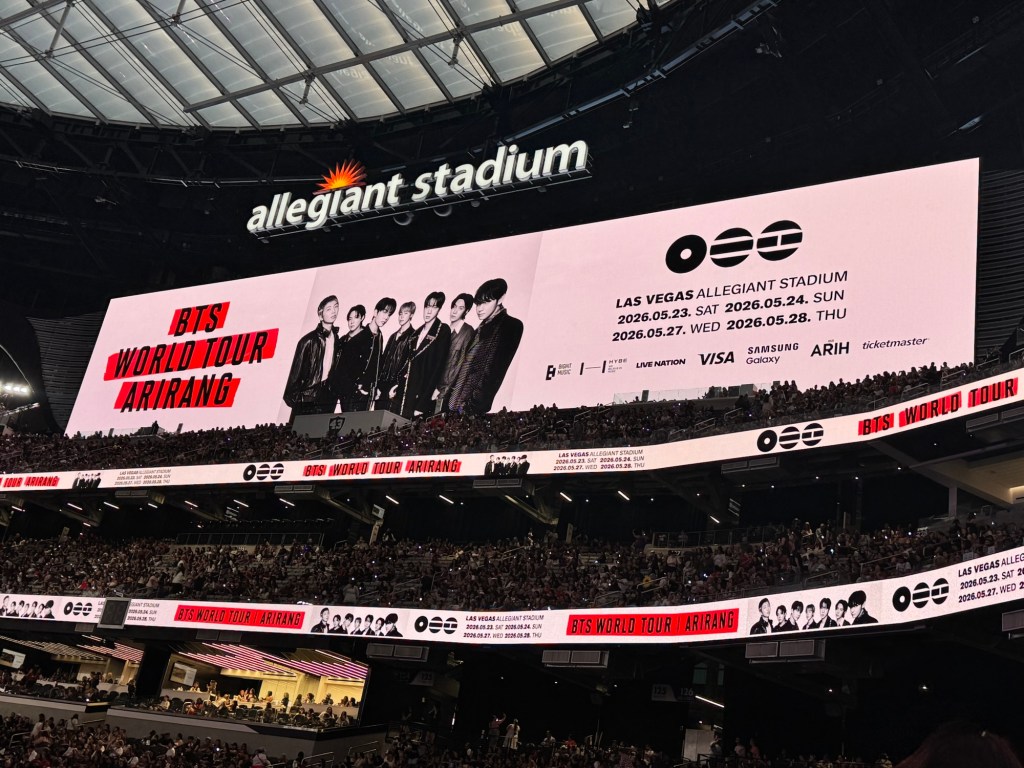
In Las Vegas, during a BTS concert weekend, time itself begins to reorganize around pilgrimage. Sleep becomes negotiable. Hydration becomes a strategic operation. Directions become rumors. Somehow, thousands of people willingly walk miles through casinos, bridges, stadium ramps, and emotional exhaustion just to arrive at one collective destination: pure joy.
It may seem like I was simply attending a concert. By the end of the night, I had participated in a temporary city built out of devotion, generosity, music, ritual, and shared emotional survival.
“People will travel anywhere for a moment that reminds them they are alive.”
That Sunday began quietly enough. My friend had an early soundcheck check-in, so breakfast plans disappeared before the day even started. Since I hadn’t arranged transportation to church, I stayed back at the hotel instead. We slept in a little, slowly recovering from the previous night’s emotional and physical marathon. Vegas has a strange way of making your body feel both overstimulated and exhausted at the same time — like your nervous system is buffering.
By late morning, we decided to head to Caesars Palace to visit the BTS pop-up shop at the Forum Shops. Originally, we planned to take the monorail from MGM Grand, but after realizing the walk to the station felt longer than a spiritual test in the desert, we surrendered and took a taxi instead. Seventeen dollars later, we arrived at the kingdom of luxury retail and fandom capitalism.
And honestly? The merchandise prices nearly sent me into another dimension.
There were giant price tags displayed outside the store like warning signs. I stared at them thinking, Lord, I already paid for flights, hotel, food, and concert tickets. I cannot finance the entire emotional economy of this fandom.
Maybe one shirt. Maybe.
Not the whole collection.
Still, the energy outside the pop-up shop felt electric. Fans lined up taking photos, scanning QR codes for the stamp rally, and documenting every inch of the experience. One security guard aggressively discouraged photos, which felt deeply ironic considering modern fandom survives almost entirely through documentation. If memory had a corporate sponsor, it would probably charge admission too.
We didn’t actually enter the shop because access was tightly controlled, but somehow that almost made the experience feel more ceremonial. The guarded doors. The crowd. The anticipation. The exclusivity. It resembled less of a store and more of a sacred chamber protected by capitalism and security personnel with Bluetooth earpieces.
Lunch, Lasagna, and Little Human Accidents
Afterward, we went to Carmine’s for lunch. We shared Caesar salad, lasagna, and soda while trying to recover from the heat and constant movement. At one point, while rearranging dishes, soda spilled across the table.
For one brief second, all glamour disappeared.
No lights.
No luxury.
No polished social media aesthetic.
Just exhausted women trying not to drown in Diet Coke.
Oddly enough, that tiny moment grounded the entire day for me. It reminded me that behind every curated travel photo are tired feet, overstimulated brains, and people simply trying their best to enjoy life without dropping something.
Thankfully, my friend didn’t get soaked.
Even more than the concert itself, I kept noticing generosity throughout the day. One friend bought multiple hats as gifts for people back home. Around us, fans continuously exchanged freebies, photocards, bracelets, and tiny handmade trinkets with strangers.
Nobody had to do any of it.
And yet they did.
“Generosity is proof that human beings still believe in each other.”
That spirit stayed with me all weekend.
Atlantis, Animatronics, and the Aging of Spectacle
While waiting for the Atlantis show at Caesars, we wandered through the atrium and shops until the hourly performance began. The animatronic show told the story of siblings battling over Atlantis before the city ultimately sank beneath the sea.
It was charming in an old Vegas kind of way, but I couldn’t stop thinking about how entertainment itself has evolved. The animatronics that once amazed audiences now feel almost antique compared to today’s AI-driven realism and interactive technologies.
As I watched the mechanical figures move stiffly beneath dramatic lighting, I thought about Sophia the humanoid robot — the one who appears on talk shows, speaks at conferences, and interacts with people with startling realism.
Vegas once built wonder through machinery.
Now wonder is built through emotional immersion.
And strangely, BTS concerts accomplish that more effectively than most modern technology.
Not because they are technologically superior — though the production is massive — but because they create emotional synchronization. Tens of thousands of strangers singing together. Crying together. Waiting together. Walking together.
That is a different kind of engineering altogether.
The Long Walk to Happiness
By evening, we prepared to head to Allegiant Stadium.
This is where the pilgrimage officially began.
We took the tram, got confused about the pickup location, accidentally exited in the wrong area, and ended up walking what felt like the entire architectural blueprint of Las Vegas. At one point, we crossed a long bridge in brutal heat while dehydrated and exhausted.
The bridge itself wasn’t even particularly dramatic.
But emotionally, it felt symbolic.
Thousands of fans moved together toward the same destination carrying banners, water bottles, light sticks, backpacks, and emotional anticipation. Nobody looked glamorous anymore. We looked committed.
Somewhere during that walk, I realized this was not entirely different from ancient pilgrimage traditions.
People have always journeyed toward places that promise transcendence.
“Let us run with endurance the race that is set before us.” — Hebrews 12:1
The modern world simply replaced cathedrals with stadiums.
The Obstructed View
After entering the stadium, I realized my seat had a partially obstructed view because of a barrier.
At first, I felt disappointed.
I could only fully see the members when they moved toward the edge of the stage, though thankfully the giant screens compensated for most of it. But eventually, something unexpected happened: the barrier stopped mattering.
Because the real experience wasn’t only happening onstage.
It was happening beside me.
Fans exchanged gifts with strangers. I spoke with a Korean ARMY from Santa Barbara who shared how overwhelmed she felt by the generosity of fandom culture. Around me were fans from Southeast Asia — possibly Indonesian or Thai — who excitedly discussed BTS between performances as though we had all known each other for years.
The atmosphere itself became the event.
And maybe that’s why people misunderstand fandom when they reduce it to celebrity obsession. What many people are actually searching for is belonging.
“2.5 Hours of Happiness”
The concert itself was extraordinary.
BTS performs with a level of precision that almost defies comprehension — fluid choreography, sharp transitions, emotional control, charisma, stamina. Their excellence feels disciplined rather than accidental.
But surprisingly, my favorite moments were not always the songs.
It was the banter.
The unscripted interactions.
The teasing.
The laughter.
The humanity between performances.
Because perfection impresses people.
Humanity connects them.
At one point, the cameras showed Diplo in the audience dancing and enjoying himself like everyone else. That image oddly captured the spirit of the night for me: joy flattening hierarchy. For a few hours, everyone became part of the same emotional current.
“Where two or three gather in love, loneliness loses its power.”
And honestly, that may be the real product being exchanged at concerts now.
Not music.
Not merchandise.
Not even performance.
But temporary relief from isolation.
As Psalm 133:1 says:
“How good and pleasant it is when God’s people live together in unity.”
For 2.5 hours, unity became tangible.
Soul Insights
1. Joy Is Becoming a Luxury Commodity
Modern life exhausts people emotionally, mentally, and spiritually. Many people are no longer simply seeking entertainment; they are searching for emotional oxygen. Concerts, fandom spaces, and communal events become temporary sanctuaries where people can feel intensely alive again. The danger is that joy itself becomes monetized, expensive, and increasingly inaccessible. Yet despite the financial burden, people continue showing up because the emotional return feels priceless.
2. Community Still Exists — Just in Unexpected Places
Many people assume society has become disconnected beyond repair, but fandom culture quietly disproves that narrative. Complete strangers exchange gifts, help each other navigate venues, share emotional experiences, and form temporary bonds without suspicion. These interactions may seem small, but they reveal a deep human hunger for connection. Sometimes community does not disappear; it simply migrates into unconventional spaces.
3. Physical Discomfort Often Precedes Emotional Transformation
The heat, exhaustion, dehydration, long walks, and logistical confusion all became part of the emotional architecture of the experience. Pilgrimage has never been convenient. There is something psychologically powerful about enduring difficulty alongside others in pursuit of meaning. The struggle itself creates emotional investment. Easy experiences are often forgettable; difficult journeys become sacred memories.
4. Modern Rituals Are Replacing Traditional Ones
I missed church that Sunday, yet I still participated in ritual behavior all day long: gathering, singing, waiting, giving, journeying, celebrating, and belonging collectively. Human beings naturally create ritual because ritual helps organize emotional meaning. Even in increasingly secular societies, the desire for shared transcendence never disappears. It simply changes form.
5. People Crave Humanity More Than Perfection
The flawless choreography was stunning, but the emotional center of the night came from unscripted moments — jokes, interactions, conversations, fan exchanges, laughter, vulnerability. In a hyper-curated digital culture, authenticity feels almost holy now. People do not merely want polished experiences; they want proof that others are emotionally present with them. Humanity has become its own form of luxury.
Final Thoughts
By the time I returned to the hotel after the concert, my body hurt.
My feet ached.
My energy crashed.
It was nearly 3 a.m. before I finally slept.
And somehow, despite all of it, I was already preparing emotionally for the next event: the American Music Awards.
That is the strange power of collective joy.
It lingers.
Long after the music ends, what remains are the emotional fingerprints:
the stranger who gave you a bracelet,
the friend who bought gifts for everyone,
the fans singing together on a bridge in the Vegas heat,
the realization that for a few brief hours, nobody wanted to feel alone.
Maybe that is why people keep making these journeys.
Not because life is empty —
but because moments of shared aliveness are rare enough to become sacred.
As Ecclesiastes 3:13 reminds us:
“That each of them may eat and drink, and find satisfaction in all their toil—this is the gift of God.”
And perhaps, in its own unexpected way, so is dancing in a stadium with seventy thousand strangers.
Call to Action
Have you ever traveled, waited, sacrificed, or endured discomfort for an experience that made you feel deeply alive afterward?
Maybe it was a concert.
A spiritual gathering.
A protest.
A family reunion.
A pilgrimage of your own.
Tell me about it in the comments. I want to know what moments reminded you that joy is still worth pursuing — even when the journey is exhausting.
© 2026 Amelie Chambord


Leave a Reply