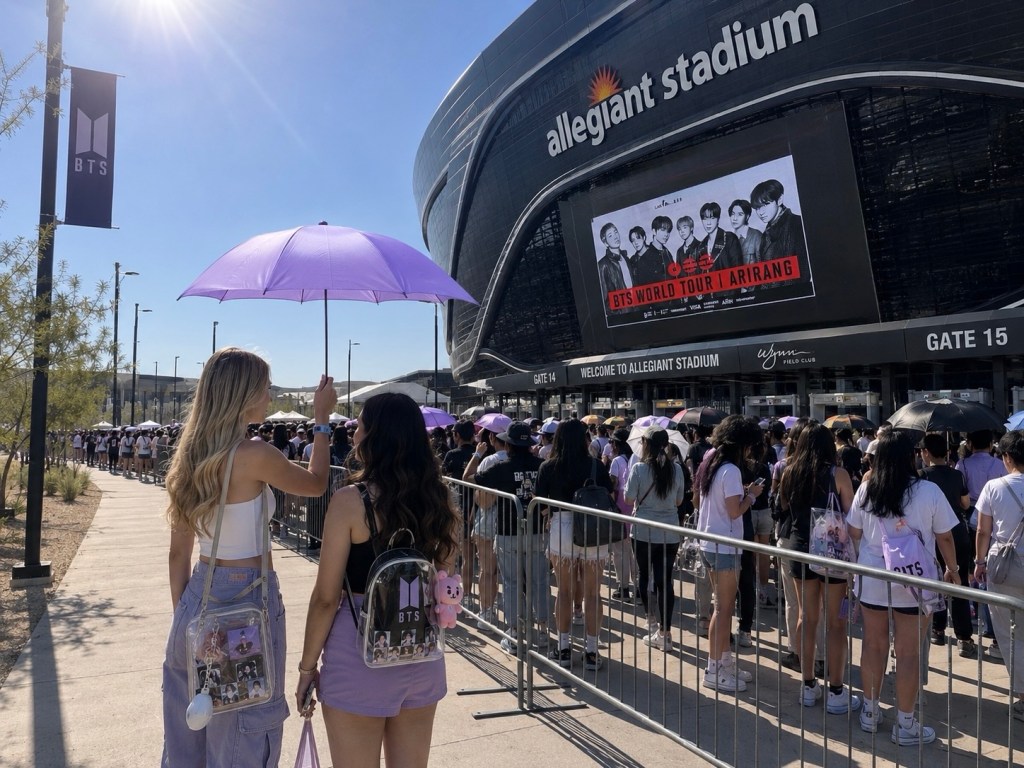
Somewhere outside a stadium in the brutal afternoon heat, a stranger lifted her umbrella slightly so I could stand beneath it too.
She didn’t know me.
We had exchanged maybe three sentences in line.
But in that moment—sweating under a relentless sun, surrounded by thousands of people slowly pressing toward the gates—that small adjustment felt strangely profound. Not because it saved me from the heat, but because it interrupted something far more common in modern life: indifference.
We live in a culture that increasingly mistakes emotional distance for maturity. People spend years inside office buildings, apartment complexes, classrooms, and cities without ever learning the names of the people beside them. We scroll through each other constantly while remaining fundamentally untouched.
And yet, outside a BTS concert, strangers shared water, shade, portable fans, sunscreen, encouragement, and concern with an instinctive tenderness that many people rarely encounter in ordinary life.
That stayed with me longer than the concert itself.
Not the lights.
Not the screaming.
Not even the music.
The umbrella.
The Long Build Toward Joy
The day began quietly.
I woke up around 8 a.m. on Saturday carrying the kind of anticipation that makes the entire day feel cinematic before it even starts. My friend from grade school picked me up after work, and we spent the afternoon together first at a Mediterranean grill, then later at Starbucks, lingering in conversation the way old friends do when history removes the pressure to impress each other.
There’s something sacred about being with people who remember earlier versions of you.
Before survival instincts hardened certain parts.
Before exhaustion became personality.
Before adulthood trained us to appear emotionally self-sufficient.
Later, we picked up her niece because she was attending the concert too. By then the city already felt transformed. Purple outfits. Light sticks. Merchandise bags. Waves of people moving toward the same destination with visible excitement written across their faces.
The traffic around the stadium was overwhelming, but nobody seemed angry about it. Anticipation softened people.
Eventually we arrived and split toward our different gates. Mine was near the field club entrance, so I walked alone toward the main gate where the line wrapped endlessly beneath the afternoon sun.
That’s where the real story started.
The People in Line
The girl in front of me had flown in from Hawaii. The people behind me drove from Phoenix.
Under ordinary circumstances, we probably would’ve remained strangers performing the silent choreography modern public life teaches us: avoid eye contact, stay polite, protect personal space.
But fandom disrupts that instinct.
Conversation happened naturally, almost immediately, because everyone there already shared a common emotional vocabulary. There was no need to explain why we came, what the music meant to us, or why thousands of people were willing to endure brutal heat just for a few hours inside a stadium.
Then someone nearby nearly passed out.
What struck me wasn’t just that people helped her. It was how fast they moved. Water bottles appeared instantly. Portable fans started circulating. Voices softened with concern instead of irritation. Nobody filmed her. Nobody treated her distress like inconvenience or spectacle.
People simply responded.
Galatians 6:2 says:
“Carry each other’s burdens, and in this way you will fulfill the law of Christ.”
Not through grand declarations.
Not through performance.
Through attentiveness.
A little later, when the heat became unbearable, the fans behind me angled their umbrella toward my side without hesitation so I could stand in the shade too.
Such a small gesture.
But small gestures often reveal the emotional condition of a culture more honestly than large ones.
Why These Spaces Feel So Emotional
By the time I finally entered the stadium, overheated and exhausted, the energy inside felt almost unreal.
My seat was right by the railing near eye level with the stage. The moment BTS appeared, the atmosphere detonated into joy so loud and collective it became physical.
I screamed. Sang every lyric. Jumped until my legs ached. Lost my voice in fan chants echoing through the stadium. The girls standing beside me became temporary companions, bonded by the strange intimacy that forms when thousands of people allow themselves to feel openly at the same time.
People often dismiss fandom culture because they only see excess.
They see screaming and assume superficiality.
What they often miss is that collective joy has become increasingly rare in public life. Many people move through daily routines emotionally armored—careful not to appear too sincere, too excited, too affected by anything. Cynicism has become a social currency. Detachment gets mistaken for intelligence.
But concerts like this create temporary spaces where emotional openness is not only accepted—it’s expected.
And that changes people, even if only for one night.
C.S. Lewis wrote:
“Friendship is born at that moment when one person says to another: ‘What! You too?’”
That recognition exists everywhere inside fandom spaces.
Not sameness. Recognition.
The recognition of loneliness.
Of survival.
Of needing music to hold emotions language couldn’t fully carry alone.
The Spiritual Weight of Small Kindnesses
What lingered with me afterward wasn’t only the performance itself, incredible as it was.
It was the emotional generosity surrounding it.
The softness.
The willingness of strangers to care for one another without suspicion.
Romans 12:10 says:
“Be devoted to one another in love. Honor one another above yourselves.”
Outside the stadium, that verse stopped feeling abstract.
I saw it in shared sunscreen.
In water bottles passed down the line.
In strangers checking whether someone had eaten.
In an umbrella quietly extended a few inches farther.
Mother Teresa once said:
“We cannot all do great things. But we can do small things with great love.”
That may be why the umbrella stayed with me so deeply.
Not because it was extraordinary, but because it wasn’t.
It was ordinary compassion offered instinctively in a world where many people have become emotionally cautious with one another.
What We’re Really Searching For
Long after the concert ended, I returned to the hotel physically wrecked. My feet felt like they were throbbing independently from the rest of my body. My makeup was gone. My voice was nearly gone too.
But internally, I felt startlingly full.
Not because a concert solved anything.
Life was still waiting outside those stadium gates. Bills. Stress. Responsibilities. The quiet ache people carry without talking about it.
But for a few hours, thousands of strangers created an environment where people could feel visible instead of isolated.
And I think that’s part of why experiences like this affect people so deeply.
We are not only searching for entertainment.
We are searching for evidence that tenderness still exists.
Hebrews 13:2 says:
“Do not neglect to show hospitality to strangers, for thereby some have entertained angels unawares.”
Hospitality doesn’t always look like inviting someone into your home.
Sometimes it looks like making room for another person’s humanity in public.
Sometimes it looks like noticing discomfort before being asked.
Sometimes it looks like an umbrella shifting slightly in your direction beneath an unforgiving sun.
Self-Assessment Questions
- Have I mistaken emotional detachment for strength while quietly longing for deeper connection?
- In what small ways do I make people feel emotionally safe, noticed, or cared for in everyday life?
- When was the last time I allowed myself to experience collective joy without self-consciousness?
Final Thoughts
There are experiences that entertain us, and then there are experiences that reveal something about the human condition.
The concert was unforgettable. The music, the energy, the electricity of thousands of voices moving together at once—I’ll remember all of it.
But years from now, I suspect the thing I’ll remember most clearly is still that umbrella.
Because in a time where loneliness has quietly become one of the defining emotional realities of modern life, even the smallest acts of attentiveness begin to feel sacred.
And maybe that’s what we’re all searching for beneath the noise, the schedules, the screens, and the exhaustion.
Not perfection.
Not constant happiness.
Just evidence that people are still capable of reaching toward one another with warmth.
Even briefly.
Even anonymously.
Even in line outside a stadium.
© 2026 Amelie Chambord


Leave a Reply