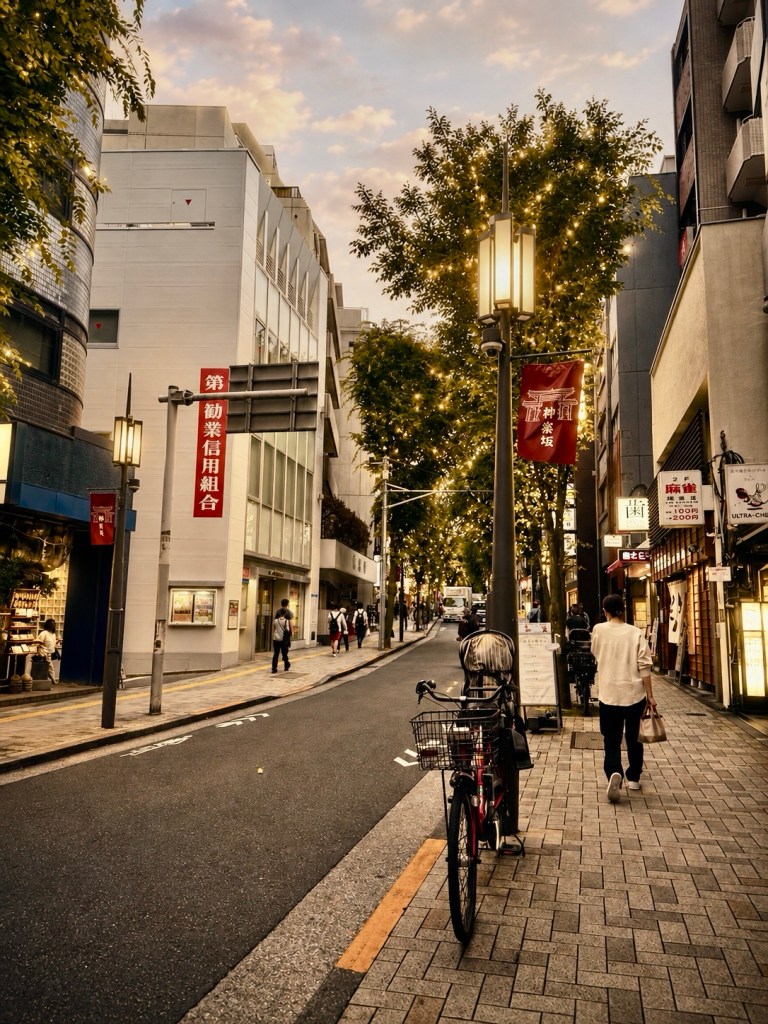
Some places give you memories. Others change the way you see your own life.
Kagurazaka did the second.
It was my final day in Japan. I had already traveled from Busan, dealt with airport lines, checked an overstuffed suitcase, and performed the delicate ritual of convincing luggage that it could hold one more thing.
It could not.
By the time I arrived at Narita Airport, I had another decision to make. My hotel was near the airport, but I wanted to spend the day in Tokyo. Dragging my luggage across the city did not sound adventurous. It sounded like an upper-body workout I had not signed up for.
So I took the hotel shuttle, left my luggage there, and packed the essentials into a small backpack.
Then I headed toward Kagurazaka.
I thought I was going there to explore a neighborhood.
Instead, I found the part of Tokyo that felt most like home.
A Friend on the Other Side of the World
I was meeting a Japanese friend I had met at the AMAs the month before.
She is also ARMY, and I believe Jungkook is her bias. We had hoped to spend time together during my previous visit, but she had fallen ill. Thankfully, she was feeling better by the time I returned.
When I told her I wanted to see Kagurazaka, she surprised me.
She lived there.
Not only had she lived there—she had called the neighborhood home for 25 years.
That changed everything.
I was no longer arriving as a tourist with a map and a list. I was being welcomed by someone who knew the streets through decades of ordinary life.
I had come to Kagurazaka expecting to discover a place.
I did not expect the place to reveal something about me.
Late for Lunch, Right on Time
My friend met me at the station after giving me careful instructions on how to get there.
By then, it was close to two in the afternoon.
I was running late.
I was tired.
And, most urgently, I was hungry.
She asked whether I had eaten. I told her I had not, so our first official activity became finding lunch.
Simple enough.
Except several restaurants were already closed for their afternoon break.
We walked from one possibility to another. I had originally wanted sushi, but travel has a way of gently laughing at your plans.
Eventually, we found a ramen restaurant.
That ramen turned out to be one of the best changes of plan I could have asked for.
The Ramen I Still Think About
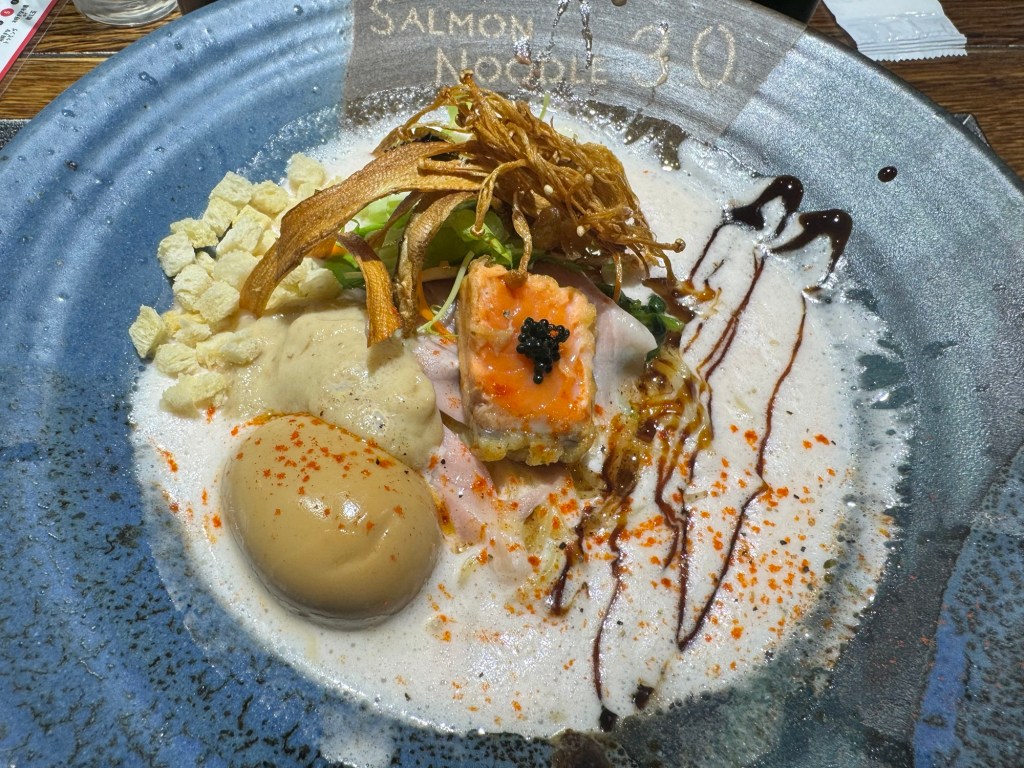
I ordered a salmon ramen with egg and a creamy broth.
The bowl was beautiful.
The broth was rich, savory, and comforting. The salmon gave it depth, while the creamy texture added something I had never experienced in ramen before. It was Japanese, but it carried a French influence that made the entire dish feel familiar and surprising at the same time.
I wish I had a more sophisticated description.
I do not.
It was awesome.
Sometimes “awesome” is the correct culinary term.
I enjoyed every bite and remember thinking that I had never tasted anything quite like it in the United States. Perhaps someone could reproduce the ingredients, but the setting would be harder to recreate.
The lateness.
The relief of finally finding lunch.
The friend sitting across from me.
The knowledge that I was eating in a neighborhood she loved.
Flavor is rarely only about food.
Seeing Kagurazaka Through Her Eyes
After lunch, we began walking.
My friend showed me where she shopped. She pointed out restaurants and explained what kinds of food they served. She took me inside a store filled with carefully selected Japanese food products.
Naturally, I wanted to buy things.
Also naturally, my luggage objected.
I avoided glass jars because I did not want them breaking in transit or causing problems on the journey home. I chose something small instead, possibly a soup packet, that could survive both my backpack and my packing habits.
At this stage of the trip, my luggage was no longer an accessory.
It was a strict financial advisor.
“No books.”
“No jars.”
“You have enough.”
It was not wrong.
A Neighborhood with Layers
As we continued walking, my friend showed me two temples and shared some of their history.
She pointed out cafés, bakeries, small restaurants, narrow streets, and hidden corners. Kagurazaka had a blend of Japanese character and French influence, visible in its food and storefronts.
Yet what affected me most was not any single building.
It was the atmosphere.
Tokyo is often imagined through crowds, bright signs, fast trains, and constant movement. Kagurazaka felt different. It was quiet without feeling empty. Peaceful without feeling disconnected.
It was still part of the city, but it seemed to move at its own pace.
The words of Psalm 46:10 came to mind: “Be still, and know that I am God.”
Kagurazaka felt like a physical reminder of that invitation.
Be still.
Pay attention.
Stop rushing long enough to notice where you are.
The Little Bookstore I Could Not Take Home
At one point, we entered a small bookstore.
It was nothing like Barnes & Noble.
It was intimate and quiet. I opened a few books, looked through the pages, and breathed in that unmistakable smell that belongs only to bookstores.
People who love books understand this.
People who do not love books may be wondering why I was smelling the merchandise.
I probably would have bought something, but my luggage once again exercised veto power.
So I left without a book.
Still, I remember that shop.
That is one of the strange gifts of travel. We often think souvenirs are the things we purchase, but some of the strongest souvenirs cannot be packed.
The smell of a bookstore.
The warmth of ramen broth.
The sound of footsteps on a quiet street.
The feeling of being welcomed.
Twenty-Five Years of Belonging
As we walked, my friend talked about living in Kagurazaka.
She had been there for 25 years. She was retired, and she seemed genuinely content with her life in the neighborhood.
I could see her connection to it in the way she pointed things out.
This was not someone reciting facts from a guidebook. She was sharing the geography of her own life.
Here was the shop she visited.
There was a restaurant she knew.
Around that corner was a place with history.
Her affection made me look more carefully.
Without her, I might have seen attractive streets and interesting storefronts. Through her eyes, I saw continuity. Routine. Community.
I saw what it might feel like to belong somewhere.
The Kindness at the End of the Day
As evening approached, it was time for me to return to my hotel near Narita.
My friend did not simply tell me which train to take and wave goodbye.
She came with me.
She helped me speak with the person at the counter about my ticket. She walked as far as she could and gave me final instructions so I would know where to go.
She had already spent hours showing me her neighborhood.
Still, she wanted to make sure I returned safely.
That is what I remember most.
The ramen was unforgettable.
The streets were beautiful.
The bookstore was charming.
But kindness was what made Kagurazaka stay with me.
T. S. Eliot wrote that the end of our exploring is “to arrive where we started and know the place for the first time.”
I did not return to where I started geographically.
But emotionally, something familiar had found me.
A quiet neighborhood.
A caring friend.
A place that made me imagine a different kind of life.
Soul Insights
1. The best places are often revealed through people
A destination can be beautiful on its own, but a person can give it meaning. My friend did not merely show me streets and buildings; she showed me where her life had unfolded. Because she loved Kagurazaka, I looked at it with more care. Sometimes we remember a place because of what we saw, but often we remember it because of who walked beside us.
2. A change of plans may be an invitation
I wanted sushi, but several restaurants were closed, and we ended up eating salmon ramen instead. That unplanned meal became one of the most memorable parts of the day. I could have focused on what did not happen, but I would have missed what was being offered. Sometimes disappointment is simply a doorway wearing an inconvenient disguise.
3. Stillness can restore what busyness has scattered
By the time I reached Kagurazaka, I had traveled through airports, trains, hotel shuttles, and the mental clutter of a final travel day. The neighborhood gave me permission to slow down. Its quiet streets did not demand anything from me; they simply invited me to notice. Stillness does not always solve our problems, but it often helps us hear what the noise has been covering.
4. Hospitality is more than showing someone around
My friend’s hospitality was not limited to pointing out restaurants or explaining history. It appeared in the way she waited for me, helped me find lunch, walked beside me, and made sure I understood my return journey. True hospitality tells another person, “Your well-being matters while you are with me.” Long after details fade, people remember how carefully they were treated.
5. Home can sometimes be recognized before it is understood
I had only spent a few hours in Kagurazaka when I began imagining myself living there. I did not know the practical realities of rent, daily routines, or carrying groceries up those hidden stairways. Still, something about the neighborhood felt peaceful and familiar. Perhaps home is not always the place we already know; sometimes it is the place that helps us recognize the life our soul has been quietly craving.
Final Thoughts
Kagurazaka became my favorite Tokyo neighborhood, but not because it had the biggest landmark or the most spectacular attraction.
It became my favorite because it felt lived in.
It held temples, bakeries, cafés, stores, side streets, and one remarkable bowl of ramen. More importantly, it held the life of a friend who had loved it for 25 years and generously allowed me to see it through her eyes.
That was my final day in Japan.
Yet it did not feel like an ending.
I had missed Tokyo Tower. I had not reached Sensō-ji. There were entire neighborhoods I had not explored.
But instead of leaving only with regret, I left with an invitation.
Come back.
Walk more slowly.
See what you missed.
Buy the book next time—assuming the suitcase allows it.
Kagurazaka reminded me that travel is not always about collecting destinations. Sometimes it is about recognizing where you felt peaceful. Sometimes it is about the person who helped you feel welcome. And sometimes a place you visit for only an afternoon quietly whispers:
You could belong here.
Your Turn
Have you ever visited a place that unexpectedly felt like home?
Share the place—and the person, meal, street, or small moment that made it unforgettable. Then send this story to someone who has shown you the world through their eyes.
© 2026 Amelie Chambord


Leave a Reply