The last time I was in Tokyo was in 1996. Thirty years later, I returned expecting to find a different city. The skyline had grown, technology had transformed daily life, and neighborhoods had continued their endless evolution. Yet as the trip unfolded, I realized the most significant change wasn’t in Tokyo. It was in the person experiencing it.
Sometimes the biggest difference between two journeys isn’t the destination. It’s the person making the trip.
On my final full day in Tokyo, I woke up with a familiar traveler’s dilemma. Part of me wanted to squeeze every remaining attraction into the day. Tokyo Tower. Zojoji Temple. Kiyosumi Garden. Kagurazaka. The unfinished list hovered in the background like a persistent notification.
Yet another part of me wanted something different.
I wanted to experience the city instead of chasing it.
What followed became the most meaningful day of my entire trip.
Not because I saw the most.
Because I finally saw differently.
A Wrong Turn and a Right Lesson
The day began with a small mistake.
As I entered the station, I instinctively followed the flow of commuters and ended up heading in the wrong direction. Everyone around me seemed to know exactly where they were going, and for a moment I became part of their momentum rather than following my own.
Halfway through the journey, something felt off.
I checked my route, realized my mistake, turned around, and found the correct platform.
No frustration.
No panic.
No internal meltdown.
Just a course correction.
That simple moment revealed more growth than any landmark I would visit that day.
As author Susan Jeffers wisely said:
“Feel the fear and do it anyway.”
Confidence is rarely the absence of mistakes. More often, it is the ability to recover from them without losing yourself.
The verse from Proverbs 24:16 came to mind:
“For though the righteous fall seven times, they rise again.”
The difference between my first days in Tokyo and my final day wasn’t navigation.
It was trust.
The Most Expensive Coffee of the Trip
I decided to begin the morning at the Starbucks Reserve Roastery in Nakameguro.
What I expected to be a quick coffee stop became a two-hour experience.
The building felt less like a café and more like an attraction. Copper transport tubes carried coffee beans throughout the structure. Each floor offered its own atmosphere. I wandered through the TEAVANA section, explored every corner, and eventually discovered a Mango Coconut Matcha drink that became one of my favorite beverages of the entire trip.
At one point I found myself sitting outside on the terrace overlooking Nakameguro.
No schedule.
No urgency.
No agenda.
Just observation.
Just presence.
Later, when I checked my receipts, I realized I had spent ¥3,340 at Starbucks.
Ironically, I had spent less money eating conveyor-belt sushi the previous day.
The realization made me laugh.
But the truth was that I wasn’t paying for coffee.
I was paying for time.
And time, when fully experienced, is often worth more than the things we purchase.
Looking for a Palace, Finding a Castle
Eventually I made my way toward the Imperial Palace.
Or at least I thought I did.
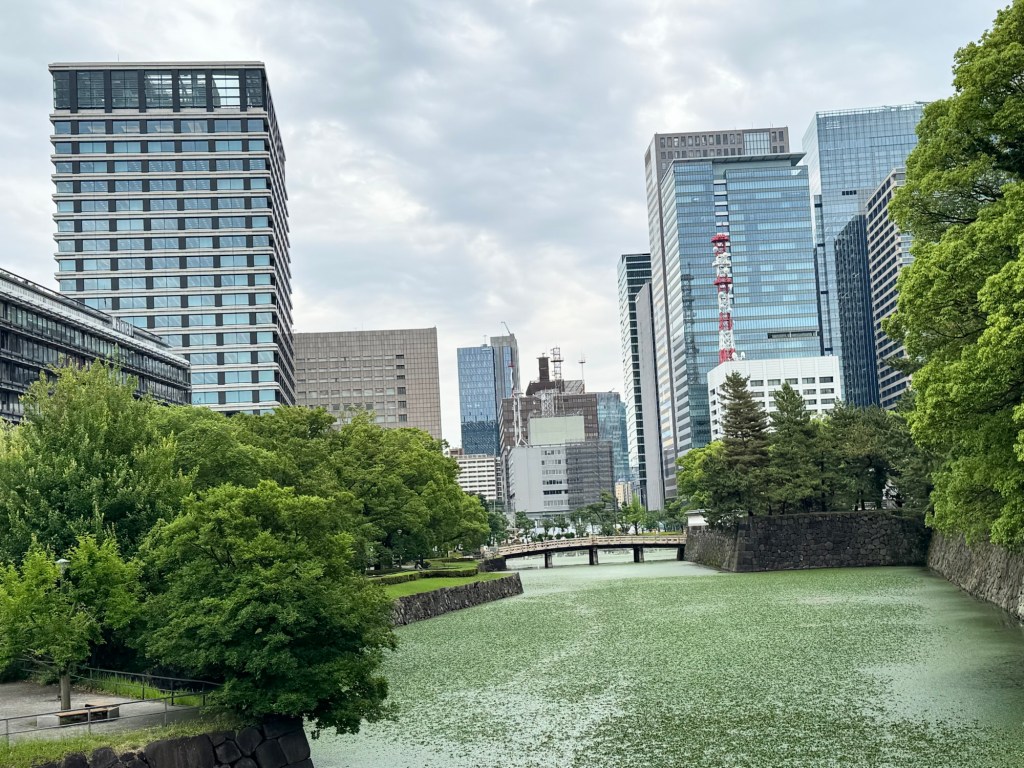
Approaching from the Hanzomon side, I found myself walking alongside enormous moats and towering stone walls that seemed to stretch endlessly into the distance.
The scale was startling.
Maps simply cannot prepare you for how massive the grounds actually are.
The farther I walked, the more I realized I wasn’t experiencing a palace.
I was walking through the remains of one of the most powerful castle complexes in Japanese history.
After navigating a fair amount of confusion, I finally entered the Imperial Palace East Gardens.
Everything clicked.
Historic gates.
Stone foundations.
Castle ruins.
Guardhouses.
Remnants of Edo Castle.
What surprised me most was not what I found.
It was what I didn’t find.
I never actually saw the Emperor’s residence.
Instead, I spent the afternoon immersed in history.
Strangely, I wasn’t disappointed.
I was fascinated.
Perhaps growth means learning to appreciate the discovery you make instead of mourning the one you expected.
As T.S. Eliot once wrote:
“We shall not cease from exploration, and the end of all our exploring will be to arrive where we started and know the place for the first time.”
Tokyo 1996 vs. Tokyo 2026
As I walked through the grounds, memories of my first Tokyo trip surfaced.
In 1996, I visited Tokyo with a military roommate.
I vaguely remember Tokyo Tower.
Beyond that, the details have faded.
We stayed close to familiar areas. We moved through the city without truly entering it.
Tokyo was a destination.
Nothing more.
This trip felt entirely different.
I navigated trains independently.
I ordered food without hesitation.
I explored temples, gardens, neighborhoods, and side streets.
I got lost.
I found my way.
I trusted myself.
The city itself had not changed nearly as much as I had.
Isaiah 43:19 captures this beautifully:
“See, I am doing a new thing! Now it springs up; do you not perceive it?”
The new thing wasn’t Tokyo.
The new thing was me.
Curry, Laundry, and Quiet Victories
Dinner at CoCo Ichibanya felt like the perfect ending.
Not extravagant.
Not ceremonial.
Just comforting.
There was something fitting about ending my final full day in Japan with a bowl of curry.
Back at the Airbnb, the evening unfolded in ordinary ways. I washed clothes, watched episodes of Sold Out on You, packed my backpack, and prepared for my flight to Busan. The washing machine eventually alerted me with a cheerful beep, reminding me it was time to finish packing.
The evening felt deeply satisfying.
The practical tasks were done.
The clothes were clean.
The backpack was ready.
Life felt manageable.
Sometimes peace arrives disguised as folded laundry.
As Lao Tzu observed:
“A good traveler has no fixed plans and is not intent on arriving.”
Soul Insights
1. Confidence Is Often Quiet
Real confidence rarely announces itself. It doesn’t require perfect execution, flawless navigation, or constant certainty. It reveals itself in how calmly we respond when things don’t go according to plan. The wrong train platform became evidence of growth because I no longer interpreted mistakes as failures. I simply adjusted and continued.
2. Presence Creates Richer Memories Than Productivity
The moments I remember most were not the busiest ones. Sitting on a terrace overlooking Nakameguro produced a deeper impression than rushing through multiple attractions. Presence transforms ordinary experiences into meaningful memories. Productivity fills calendars, but presence fills souls.
3. Unfinished Journeys Are Invitations
I never made it to Tokyo Tower. I never visited Zojoji Temple. I never wandered through Kagurazaka. Earlier versions of myself might have considered that failure. Now I see unfinished experiences as reasons to return rather than evidence of inadequacy.
4. Growth Changes What We Notice
The city was not fundamentally different from the one I visited decades ago. What changed was my ability to engage with it. Maturity often reveals itself through perception. We begin seeing layers that were always present but previously invisible.
5. Ordinary Moments Carry Extraordinary Meaning
Travel stories usually focus on iconic landmarks. Yet some of the most meaningful moments involve coffee, conversations, train rides, and laundry. These ordinary experiences create emotional texture. They remind us that life happens between the highlights.
Final Thoughts
As my final evening in Tokyo came to a close, I found myself reflecting on two versions of the same city.
Tokyo in 1996 was a city I visited.
Tokyo in 2026 became a city I experienced.
The streets were still there.
The trains were still running.
The landmarks still stood.
The difference was that I arrived this time with greater curiosity, greater confidence, and a greater willingness to let the city reveal itself at its own pace.
Perhaps that is true of more than travel.
Perhaps the places that change us most are often the same places we once overlooked.
The world remains remarkably consistent.
We become the variable.
Your Turn
Have you ever returned to a city, a relationship, a dream, or a season of life and realized the biggest change wasn’t the place—but you?
Share your experience in the comments. I’d love to hear about a moment when you discovered that growth had quietly transformed the way you see the world.
© 2026 Amelie Chambord


Leave a Reply