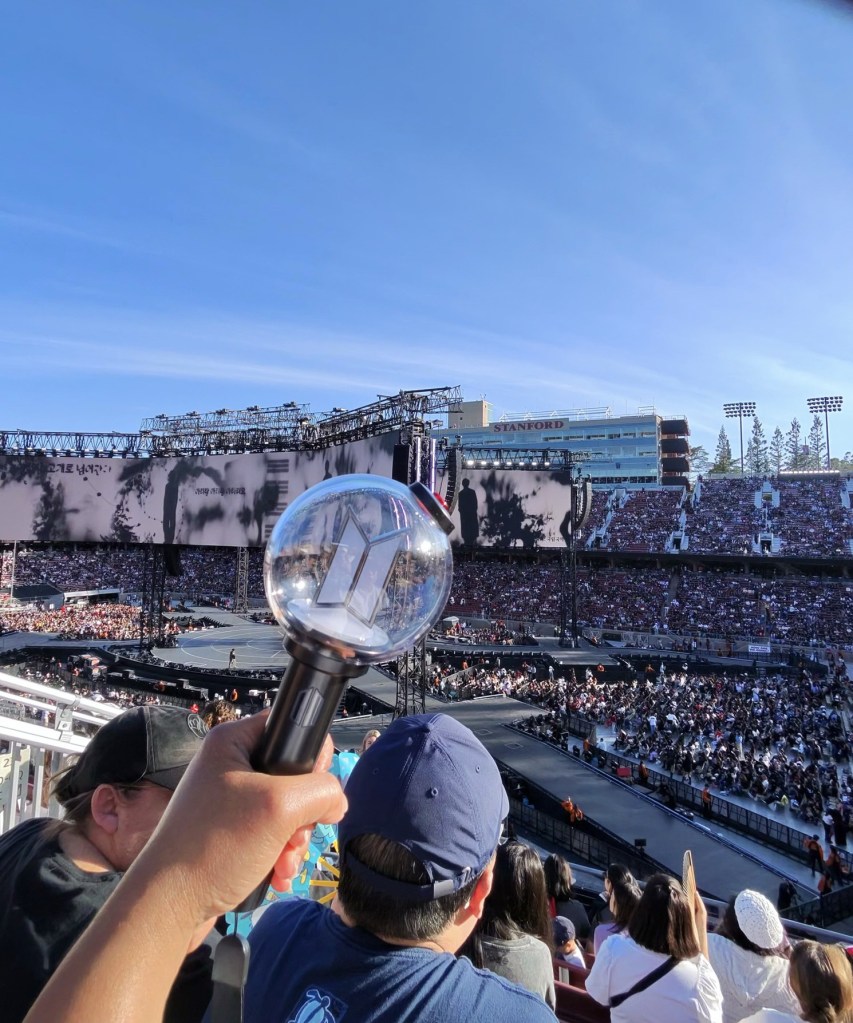
Stanford Day 1 started with road trip laughter, fan chants interrupting stories mid-sentence, gas station stops, and the kind of excitement that makes people function on three hours of sleep and pure adrenaline.
By the time we reached Stanford, the atmosphere already felt charged. ARMYs were everywhere carrying banners, photocards, portable chargers, snacks, folding fans, slogans, and enough emotional support items to survive both a concert and a natural disaster.
Then came the line.
Or rather, the four lines.
One staff member casually announced there were multiple entrances, and suddenly hundreds of people moved like water trying to find the fastest current. My friends and I ran toward one of the gates expecting two hours of waiting under the California sun.
Instead, we got in surprisingly fast.
That should have been the stressful part of the day. Yet what stayed with me most had nothing to do with logistics, stage production, or even the setlist.
It was the giving.
Not performative giving.
Not influencer-content giving.
Actual generosity from ordinary people.
The kind that asks for nothing back.
The Economy of Freebies
Before the concert even started, ARMYs handed me free gifts.
Photocards. Bracelets. Stickers. Snacks. Handmade items.
One girl carefully explained which member inspired her bracelet design before placing it into my hand like she was passing along a tiny piece of joy. Another person offered freebies with the seriousness of someone distributing emergency supplies during a storm.
Nobody asked who had more followers.
Nobody checked income levels.
Nobody asked what section your seat was in.
For a few hours, the environment operated on generosity instead of transaction.
Modern culture trains people to calculate value constantly. What do I gain from this interaction? What can this person do for me? Is this exchange worth my energy?
Yet ARMY often functions differently.
Luke 6:38 says, “Give, and it will be given to you.” The verse often gets reduced to money conversations, but generosity stretches far beyond finances. Attention is generosity. Encouragement is generosity. Time is generosity. A handmade freebie created after someone worked a full-time job all week is generosity too.
One quote from writer Kent Nerburn came to mind during the concert: “It is much easier to become a father than to be one.” In many ways, generosity works the same way. Anybody can spend money once. Consistent kindness requires intention, preparation, thoughtfulness, and discipline.
Those bracelets didn’t magically appear.
Someone sat at a table assembling them bead by bead while probably balancing work, stress, bills, exhaustion, and life.
That matters to me.
Small Gifts, Big Humanity
One of the most overlooked parts of fandom culture is how often people take care of strangers.
I watched ARMYs help each other find seats. Share sunscreen. Hold spots in line. Offer water. Explain stadium directions. Take photos for solo attendees. Translate for international fans.
Nobody held a staff meeting about it.
The culture simply developed that way.
Galatians 6:2 says, “Carry each other’s burdens, and in this way you will fulfill the law of Christ.” Most people imagine “burdens” as catastrophic grief or major life crises. Sometimes burdens look much smaller. Heat exhaustion in a stadium line. Anxiety about attending alone. Feeling overwhelmed in a crowd of thousands.
A tiny act of care can completely change somebody’s experience.
At one point during the concert, I looked around the stadium and realized how many people traveled across states and countries just to share this night together. Different languages. Different ages. Different careers. Different lives.
Yet for those few hours, everybody understood the assignment: joy shared multiplies.
Author Frederick Buechner once wrote, “You can survive on your own. You can’t live on your own.”
That line followed me throughout the night.
Because the truth is, people are starving for community more than they admit.
A Culture Built on Remembering
One reason ARMY giving culture feels emotionally powerful is because many fans remember what it felt like to arrive nervous, overwhelmed, or alone.
So they become the person they once needed.
That is discipleship in everyday clothing.
Not from a pulpit.
Not from a stage.
From lived behavior.
The girl handing out freebies today may have once been the person standing awkwardly outside her first concert wondering if she belonged.
Now she helps somebody else belong.
That cycle matters.
Ephesians 4:32 says, “Be kind and compassionate to one another.” Compassion often sounds abstract until you see it practiced in real time. Compassion looks like a stranger handing you a bracelet because she wanted somebody’s day to become brighter.
Simple.
Human.
Direct.
Writer Simone Weil once said, “Attention is the rarest and purest form of generosity.”
That may explain why these interactions feel so meaningful.
People remember when they were seen.
The Spiritual Side of Shared Joy
Church communities often talk about fellowship, but honestly, I’ve seen some churches with less warmth than a BTS concert parking lot.
That is not criticism. It is observation.
People long for environments where joy feels safe to express openly.
At Stanford, nobody apologized for excitement. Nobody rolled their eyes at emotional investment. Nobody acted too cool to participate. Fans sang, laughed, traded gifts, screamed lyrics, and celebrated together without embarrassment.
Community flourishes wherever people feel permission to fully arrive as themselves.
That realization stayed with me long after the concert ended. Perhaps generosity is less about money and more about emotional posture.
Closed people rarely give freely.
Fearful people rarely create welcoming spaces.
Hurting people often struggle to pour outward.
Yet healed people?
Connected people?
Grateful people?
They tend to overflow.
Stanford Day 1 overflowed everywhere.
Soul Insights
1. Generosity creates emotional safety.
People relax differently when they sense kindness around them. A stadium filled with tens of thousands of strangers could have felt cold or chaotic, yet the giving culture softened the entire environment. Small exchanges lowered social tension almost immediately. Human beings open emotionally when they feel welcomed instead of evaluated. That principle applies far beyond concerts into friendships, churches, workplaces, and families.
2. Community is built through repeated small actions.
Grand speeches rarely create belonging on their own. Consistency does. A bracelet here, directions there, shared sunscreen somewhere else. Tiny moments accumulate until a culture forms. Healthy communities usually grow through ordinary people repeatedly choosing consideration over convenience.
3. Shared joy heals more than people realize.
Modern adulthood trains many people into emotional restraint. Bills, stress, deadlines, and responsibilities slowly compress emotional expression. Concert spaces sometimes reopen parts of people that survival mode buried. Singing together, laughing together, and celebrating together reminds people they still carry aliveness inside them. Joy itself becomes restorative.
4. People remember how others made them feel during vulnerable moments.
Large events can feel intimidating, especially for solo attendees or introverts. One kind interaction can completely reshape somebody’s memory of an experience. That truth extends into everyday life too. Most people carry invisible pressures while moving through the world. Gentle treatment leaves deeper impressions than many realize.
5. Giving reveals abundance thinking.
Generous people usually believe joy expands when shared. Scarcity mentality hoards. Abundance mentality distributes. ARMY freebie culture operates almost like collective emotional investment where people contribute to the atmosphere itself. That spirit reflects something spiritually important too: gratitude naturally becomes generosity when the heart feels full.
Final Thoughts
Stanford Day 1 gave me more than a concert memory.
It reminded me that human beings still carry the ability to care for each other without needing profit, status, or recognition attached to it.
In a culture dominated by algorithms, monetization, personal branding, and transactional networking, watching strangers freely give to one another felt deeply refreshing.
Almost corrective.
Maybe that is part of why ARMY resonates so strongly with people around the world. Beneath the music exists a culture where many fans actively practice thoughtfulness toward strangers.
And honestly?
The world could use more of that spirit right now.
Your Turn
When was the last time you gave something freely without expecting recognition or return?
What kind of emotional atmosphere do people experience when they interact with you: pressure, indifference, warmth, encouragement, or care?
Have you become the kind of person you once needed during your own lonely or uncertain seasons?
© 2026 Amelie Chambord


Leave a Reply