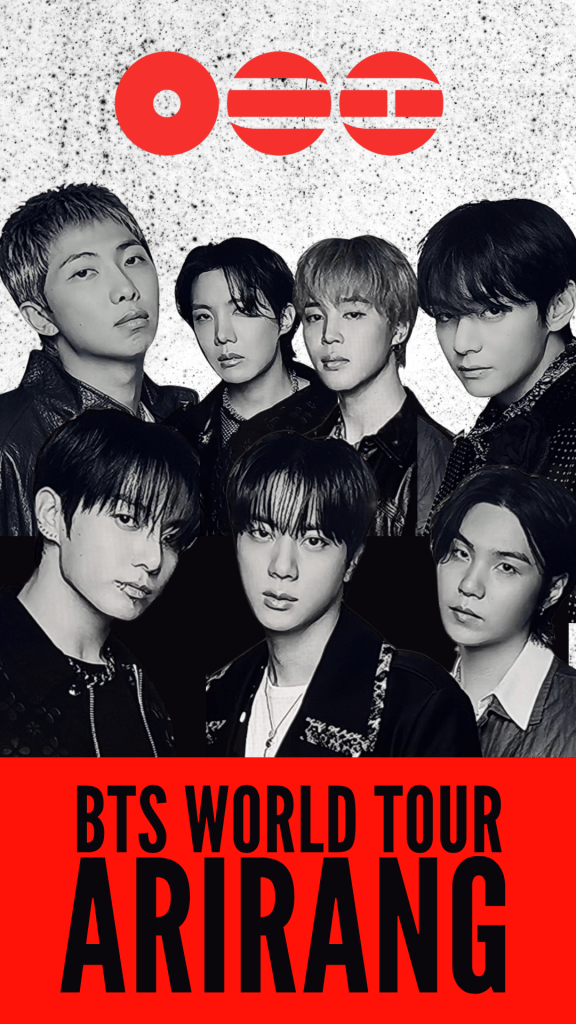
I keep coming back to something that should be obvious, but somehow still gets lost whenever we talk about BTS:
They are Korean.
I know. Groundbreaking revelation. Seven men from South Korea are, in fact, Korean.
But stay with me.
Because sometimes the way BTS is discussed, especially in Western spaces, you would think Korea is simply where they happened to be born before becoming “global.”
As though becoming internationally famous somehow made them culturally neutral.
It didn’t.
BTS can sell out stadiums in Los Angeles, collaborate with Western artists, speak at the United Nations, work with producers from all over the world, release songs in English, and understand Western pop culture better than many of us understand Korean pop culture.
They can do all of that and still be deeply Korean.
In fact, RM has said it plainly: “We are all Koreans and we are proud of where we came from.”
I think we should take him seriously.
Because if we really want to understand BTS, not just love their music, not just recognize ourselves in their lyrics, but actually understand something about the people behind the music, then Korea cannot be treated as background information.
It is part of the story.
And sometimes I think we get BTS wrong because we keep trying to interpret seven Korean men through assumptions that feel normal to us simply because they are normal to us.
That is not the same thing.
Proverbs 18:2 says, “Fools find no pleasure in understanding but delight in airing their own opinions.”
That verse feels painfully appropriate for fandom discourse sometimes.
Before deciding what BTS meant, what they should do, what they should value, how they should behave, or why they responded a certain way, maybe the better question is:
What am I missing?
Western Is Not the Default Setting for Humanity
This is really the heart of what I am trying to say.
Western culture is a culture.
That sounds obvious too, but Western ideas are often treated as though they are simply common sense.
Ideas about independence.
Success.
Adulthood.
Family.
Authority.
Masculinity.
Privacy.
Love.
Work.
Ambition.
Individual freedom.
How much you owe your parents.
How you interact with someone older than you.
What it means to belong to a group.
Those things are shaped by culture.
They are not downloaded into every human being at birth.
So when BTS does something that seems confusing from an American or broadly Western perspective, I do not think our first response should always be, “Why are they like that?”
Sometimes I think the better question is:
Why does this feel strange to me?
Because maybe they are not the strange ones.
Maybe we are simply standing in different places.
And that does not mean Western people cannot relate to BTS. Obviously we can. ARMY would not exist on this scale otherwise.
It means we can relate to a certain extent without assuming that our worldview explains everything about theirs.
There is a difference.
But BTS Loves Western Music
Yes.
This is where I argue with myself.
Because somebody reading this could easily say, “Amy, BTS was heavily influenced by American hip-hop. They work with Western producers. They have lived and worked in Los Angeles. They listen to Western artists. How can you say we cannot understand them through a Western lens?”
Fair question.
I am not saying Western culture has no place in understanding BTS.
That would be ridiculous.
Their early music would not exist in its current form without hip-hop. They have spent years learning from artists and musicians outside Korea. They are internationally experienced men living in a world where cultures constantly overlap.
But influence is not erasure.
You can love another culture without becoming that culture.
You can learn from another place without forgetting where you came from.
RM once described himself very simply as “a real Korean person.”
That sentence stays with me because he did not say it before BTS became famous.
He said it after traveling the world.
After international success.
After experiencing cultures far beyond Korea.
Apparently seeing more of the world did not make him feel less Korean.
Maybe it made him understand his Koreanness differently.
There is something powerful about that.
Korean Does Not Mean “All Koreans Think the Same”
Now we need to be careful.
Because the easiest way to correct one bad interpretation is to create another one.
If I say, “Stop viewing BTS entirely through Western culture,” and then turn around and say, “Well, Koreans believe this and Koreans behave like that,” I have accomplished absolutely nothing.
I have simply moved BTS into another box.
South Korea is not one personality.
There are generational differences, political differences, religious differences, regional differences, class differences, family differences, and millions of people who disagree with each other every day.
And BTS themselves are seven wildly different men.
Anyone who has watched enough BTS content already knows this.
They cannot even consistently agree about food without turning it into an event.
So no, Korean culture does not explain every decision BTS makes.
Sometimes Jin is just Jin.
Sometimes Jungkook likes something because Jungkook likes it.
Sometimes Yoongi says something because that is Yoongi’s personality.
And sometimes a song really is just meant to be fun.
We do not need to drag the entire history of the Korean peninsula into every dance break.
But culture still matters.
The mistake is thinking that because culture cannot explain everything, it explains nothing.
History Does Not Stay in History Books
This is where I think understanding Korea becomes important.
Korean history is intense.
Colonization under Japan.
Liberation.
Division.
The Korean War.
Poverty.
Authoritarian governments.
Democratization.
Industrialization.
An economy that transformed at extraordinary speed.
And the continuing reality that the Korean peninsula remains divided.
This did not happen five hundred years ago.
Some of it sits within living family memory.
James Baldwin wrote, “People are trapped in history and history is trapped in them.”
I do not read that as saying people are prisoners of the past.
I read it as a reminder that history does not politely end when a textbook chapter ends.
It enters families.
It shapes fears.
It affects what parents teach their children.
It influences how societies think about security, education, sacrifice, work, success, reputation, duty, and survival.
So when we talk about BTS and things like military service, hierarchy, family, achievement, group responsibility, or national pride, Korean history matters.
It does not provide a magical answer key.
But without it, we may miss part of the question.
ARIRANG Makes This Conversation Impossible to Ignore
And then BTS went and named the album ARIRANG.
Of all things.
After the solo years.
After military service.
After separation.
After becoming individually successful.
After fifteen years of becoming one of the biggest musical acts in the world.
They came back and chose a word rooted deeply in Korea.
j-hope explained the intention behind the album this way:
“It was all about showcasing who we are, our identity and our roots.”
There it is.
Identity.
Roots.
Those are not decorative words.
And Arirang itself is not simply an old Korean song people sing because it sounds nice.
It carries generations of longing, separation, sadness, endurance, movement, and return.
That does not mean every BTS interpretation of Arirang has one fixed meaning.
But I think we would be doing ourselves a disservice if we listened to an album called ARIRANG while treating its Korean context as optional.
Their roots are not an Easter egg.
They told us they matter.
“But Their Music Is Universal”
Yes.
Absolutely.
And I think this is where people sometimes hear an argument I am not actually making.
You do not need a degree in Korean history to love BTS.
You do not need to understand Confucianism before crying to one of their songs.
You do not need to speak Korean before their music is allowed to mean something to you.
That would defeat one of the most beautiful things about art.
BTS has reached people who live completely different lives from theirs.
Different countries.
Different languages.
Different religions.
Different ages.
Different family structures.
Different histories.
And somehow we meet inside the music.
Psalm 133:1 says, “How good and pleasant it is when God’s people live together in unity!”
Unity is not sameness.
That matters.
The fact that I can understand BTS emotionally does not mean our backgrounds are identical.
Maybe that is exactly why the connection is so remarkable.
Their music does not have to become less Korean for me to find myself inside it.
And I should not have to make BTS more like me before I can love them.
Where ARMY Can Get Into Trouble
This is probably the part that makes me squirm a little, because fandom is built on interpretation.
We analyze lyrics.
We analyze performances.
We analyze interviews.
We analyze looks between members like somebody has placed us in charge of a federal investigation.
Sometimes it is hilarious.
Sometimes it is insightful.
Sometimes we are absolutely projecting.
There is a huge difference between saying:
“This song means this to me.”
and saying:
“This is definitely what BTS means.”
The first belongs to us.
The second makes a claim about them.
And I think we should leave room for the possibility that our personal interpretation may not completely match the cultural or personal place from which BTS created something.
That does not ruin the song.
It actually makes it more interesting.
Chimamanda Ngozi Adichie once said that the problem with stereotypes is not that they are always false, but that they are incomplete.
I think the same can be said about interpretation.
Our perspective may contain truth.
It simply may not contain the whole truth.
BTS Can Be Korean and Global at the Same Time
I do not think we have to choose.
That may actually be the point.
BTS can be Korean and heavily influenced by American hip-hop.
They can value aspects of Korean culture and challenge other aspects of it.
They can care deeply about group identity and still grow as individuals.
They can make music in Los Angeles and call the album ARIRANG.
They can speak to people around the world without becoming culturally generic.
They can change.
They can evolve.
They can disagree with expectations placed upon them.
They can surprise us.
And they can still be Korean.
Identity is not erased every time we learn something new.
Sometimes it becomes clearer.
James 1:19 tells us to be “quick to listen, slow to speak.”
That might be one of the healthiest approaches we can bring into fandom.
Listen first.
Learn something.
Then interpret.
Soul Insights
1. Familiarity can fool us into thinking we understand everything
BTS has been present in ARMY’s lives for years, so it is easy to feel as though we know them. We know their humor, their habits, their music, their struggles, and pieces of their history. But familiarity is not the same thing as complete understanding. Sometimes caring about someone means admitting there are parts of their world we still need to learn.
2. Difference does not make connection weaker
I do not need BTS to think exactly like me for their music to reach me. In fact, there is something beautiful about knowing that people separated by language, culture, geography, and experience can still find each other emotionally. We keep acting as though difference is a problem to solve when maybe it is simply part of being human. Connection does not require us to erase what makes us different.
3. Learning someone’s history is another way of listening
When I learn more about Korea, I am not trying to turn BTS into a history lesson. I am trying to understand more of the world that existed around them before I ever knew who they were. History gives context to values, tensions, expectations, and references I might otherwise miss. Sometimes listening means doing a little more than pressing play.
4. Roots do not prevent growth
I love that BTS can work all over the world and still come back to something called ARIRANG. There is something reassuring about that. Growing does not always mean leaving everything behind. Sometimes the strongest growth happens when we know what we are carrying with us.
5. Respect leaves room for mystery
ARMY loves BTS fiercely, but love does not give us ownership over every thought, decision, belief, or private part of their lives. We can interpret their art while still admitting that we may not always know exactly what they meant. We can be curious without becoming entitled. There is humility in saying, “This is what I see, but I am still listening.”
Final Thoughts
The more I think about this, the less interested I am in arguing that BTS “does not fit” Western culture.
That is still another box.
What I am more interested in is this:
Why should Western culture get to be the box in the first place?
Why do we sometimes treat Western assumptions as the starting point and everything else as the variation?
BTS is global.
BTS is influenced by Western music.
BTS has learned from people around the world.
BTS is made up of seven individual men who will never fit neatly inside anybody’s cultural theory.
And BTS is Korean.
All of those things can be true.
Maybe understanding them better begins when we stop trying to decide which identity cancels the others.
Learn Korea because it adds something.
Learn its history because context matters.
Listen to how BTS talks about Korea rather than deciding for them what Korea should mean.
Notice the language.
Notice the references.
Notice when something does not immediately make sense to you.
Instead of dismissing it, get curious.
Because I do not think the most remarkable thing about BTS is that seven Korean men somehow became understandable to the rest of the world.
I think the remarkable thing is that they kept bringing their world with them, and millions of us decided to meet them there.
Your Turn
The next time you listen to ARIRANG, try something.
Do not only ask:
What does this song mean to me?
Ask:
What might I hear differently if I understood more about where BTS comes from?
Learn one thing about Korea you did not know before.
Read about modern Korean history.
Learn why Arirang carries so much weight.
Pay attention to Korean words that translations flatten.
Learn about age, hierarchy, regional identity, family, military service, education, colonization, division, modernization, or whatever sends you down the next rabbit hole.
Not because you need to become an expert.
And certainly not because you need permission to love BTS.
Do it because people become more interesting when we stop assuming we already understand them.
And maybe somewhere in all that learning, we hear BTS a little differently.
Not because they changed.
Because we listened better.
© 2026 Amelie Chambord


Leave a Reply