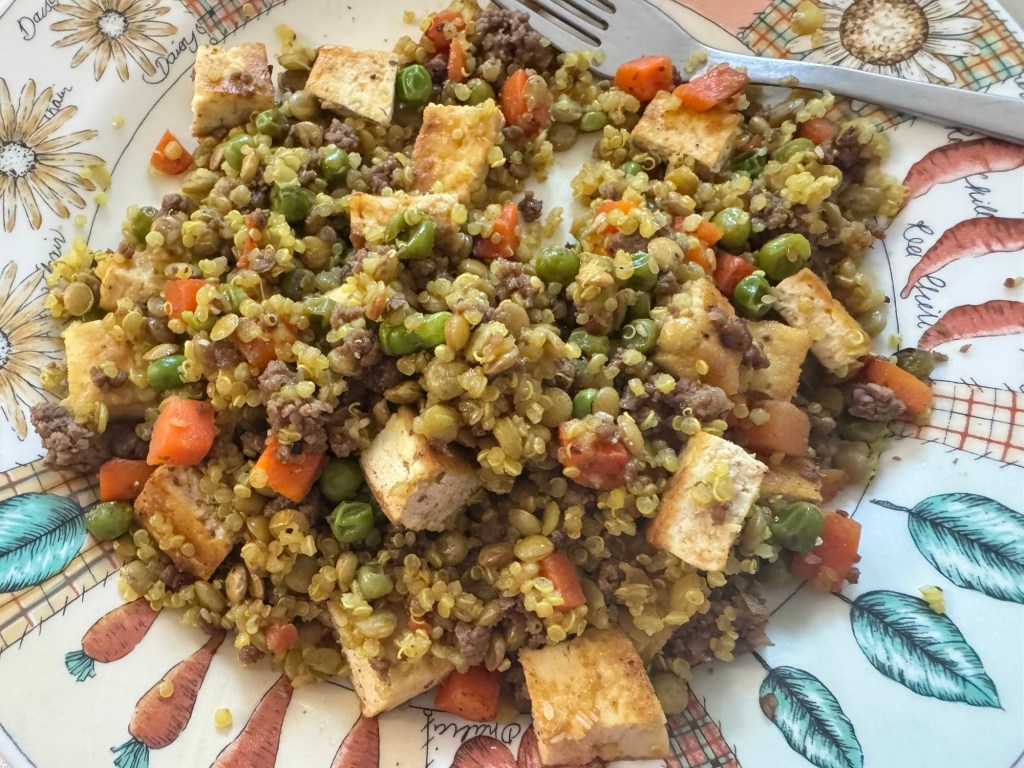
It started with a plate of food.
Nothing profound was supposed to happen.
I had made myself what I can only describe as a protein-heavy bowl of goodness: quinoa, lentils, ground beef, tofu, peas, carrots, and whatever else had found its way into the pan. It was colorful, filling, and substantial enough that looking at it made me wonder what, exactly, was about to happen once I ate it.
So I asked a simple question:
What is this plate going to do to my body?
That question sent me down a biological rabbit hole I was not expecting.
Because while I was sitting there looking at my lunch, my body already knew exactly what to do with it.
I didn’t have to supervise.
I didn’t have to tell my stomach, Okay, the lentils are coming. Get ready.
I didn’t need to remind my pancreas that carbohydrates were on the way or send an internal memo to my intestines informing them that protein had entered the building.
I ate.
And the factory went to work.
Lunch Becomes Raw Material
The food on my plate looked like food to me.
My body saw raw materials.
The protein would eventually be broken down into amino acids that could be used to maintain and repair tissue. The carbohydrates would be broken down into smaller sugars that could be used for energy. The fats would provide energy and materials needed for cell membranes and other functions. Vitamins and minerals would become tiny participants in countless chemical reactions happening throughout my body.
Even the fiber had somewhere to go and something to do.
The more I thought about it, the more ridiculous my original understanding of eating seemed.
We tend to think:
I’m hungry, so I’ll eat.
Which is true.
But underneath that very ordinary act is something extraordinary.
I am feeding cells.
Billions upon billions of living cells are depending on a continuous supply of oxygen, water, nutrients, minerals, energy, and raw materials while collectively performing the rather ambitious task of keeping this entire person alive.
That puts lunch in a different light.
Suddenly my lentils have responsibilities.
The Factory I Never Have to Manage
What fascinates me most is that I don’t consciously control any of it.
Right now, while I am writing this, my heart is beating.
I am not telling it to beat.
My lungs are moving air.
My kidneys are filtering my blood.
My liver is processing substances.
My digestive system is handling whatever I last ate.
My immune system is monitoring territory I cannot see.
Cells are being replaced. Proteins are being dismantled and rebuilt. Electrical impulses are traveling through nerves. Blood is moving oxygen and nutrients through an enormous transportation network.
And I am sitting here thinking about it.
There is something almost comical about the division of labor.
My responsibility is apparently:
Eat the food.
Then my body responds:
Thank you. We’ll take it from here.
It may be the most efficient factory I will ever encounter.
There is no human resources department.
No weekly staff meeting.
No supervisor reminding my liver about quarterly goals.
The machinery simply continues.
Day after day.
Year after year.
Mostly without my awareness.
Walt Whitman once wrote, “I sing the body electric.”
The older I get, the more I understand why someone would want to.
The Strange Miracle of Skin
Then my curiosity moved outward.
I started thinking about skin.
That covering I barely notice most days is holding together this entire operation.
Underneath it are blood vessels, nerves, connective tissue, muscles, bones, organs, fat, and fluid. Yet from the outside, everything looks remarkably contained.
Skin isn’t decorative wrapping.
It is protection.
It helps create a boundary between everything happening inside me and everything happening outside me. It participates in temperature regulation. It allows me to feel heat, cold, pressure, pain, and touch. It repairs itself when damaged. It helps defend against things that should not enter.
All of that from something I mostly think about when it feels dry or when I notice a wrinkle.
William Blake wrote, “The body is that portion of Soul discerned by the five Senses.”
That sentence lands differently when you begin thinking about how thoroughly our existence is experienced through a body.
I hear music because I have ears and a nervous system capable of processing sound.
I watch sunsets through eyes.
I hug someone with arms.
I laugh using lungs, muscles, vocal cords, and breath.
I play the piano through fingers capable of translating thought into movement.
I pray inside a body.
I write inside a body.
I love people through a body.
Our physical existence is not incidental to the life we experience here.
This Very Expensive Chunk of Meat
Somewhere during this conversation with myself, I realized something else:
The human body is extremely high-maintenance.
It requires food.
Water.
Sleep.
Movement.
Protection.
Temperature regulation.
Medical care.
Rest.
And apparently it would like vegetables occasionally.
This is an expensive chunk of meat to keep operational.
Yet even that description, funny as it is, began opening into something deeper.
Because Christianity does not treat the body as meaningless packaging around the important spiritual part of us.
Paul writes:
“Know ye not that your body is the temple of the Holy Ghost which is in you…?”
1 Corinthians 6:19
A temple.
Not disposable packaging.
Not an inconvenient biological suitcase carrying the soul around.
A temple.
That changes the language of care.
Feeding the body becomes stewardship.
Resting becomes stewardship.
Moving becomes stewardship.
Seeking medical care when something is wrong becomes stewardship.
Even learning how the body works can become an act of wonder.
Psalm 139:14 says:
“I will praise thee; for I am fearfully and wonderfully made.”
I have read that verse many times.
But sometimes familiarity makes beautiful words too comfortable.
Then something as ordinary as a bowl of quinoa and lentils wakes them up again.
Wonderfully made.
There are entire systems inside me operating at this exact moment that I cannot see, cannot hear, and do not consciously command.
Yet my life depends upon them.
Every second.
Ludwig Wittgenstein wrote, “The human body is the best picture of the human soul.”
Perhaps part of spiritual attentiveness is learning to notice the miracle we inhabit every day.
We Are More Dependent Than We Realize
There is something humbling about realizing how little conscious control I have over staying alive.
I participate, certainly.
I decide whether to eat nourishing food.
I decide whether to sleep.
I decide whether to move my body.
I make choices that can support or strain the systems within me.
But I do not personally conduct the orchestra.
God designed processes that continue whether I understand them or not.
Genesis says:
“And the LORD God formed man of the dust of the ground, and breathed into his nostrils the breath of life.”
Genesis 2:7
Dust.
Breath.
Life.
Cells.
Blood.
Bone.
Spirit.
Consciousness.
Somehow, here we are.
Perhaps that is why thinking about biology doesn’t make God seem smaller to me.
It makes existence seem more astonishing.
The closer I look, the more there is to look at.
Soul Insights
1. Ordinary things become extraordinary when I pay attention.
I could have eaten my lunch without giving it another thought. Instead, curiosity transformed a plate of food into a lesson about life itself. Much of what sustains us happens quietly enough that we stop noticing it. Sometimes wonder begins simply by asking, What is actually happening here?
2. My body deserves care because it is doing enormous work for me.
It is easy to criticize a body because of its size, shape, age, scars, wrinkles, or limitations. Yet beneath all those judgments is an organism fighting relentlessly to keep us alive. My heart has been beating for decades without taking a vacation. Perhaps gratitude belongs in the conversation about our bodies more often than criticism does.
3. Nourishment is bigger than weight.
Food conversations can become obsessed with calories, scales, and shrinking ourselves. Those things may matter in certain health goals, but food is also information, energy, building material, pleasure, culture, memory, and maintenance. When I eat, I am supplying a living system. That perspective encourages wiser choices without turning every meal into a moral exam.
4. Rest is not the absence of activity.
I may be lying completely still while my body continues doing astonishing amounts of work. Sleep does not mean the factory closes. It means different departments become especially active in restoration and regulation. Remembering this helps me see rest not as wasted time but as part of the maintenance schedule.
5. Curiosity can become worship.
There are moments when learning something about the human body moves beyond information and becomes reverence. I can learn about digestion, cells, nerves, blood, skin, and metabolism scientifically while still standing in wonder before the fact that any of it exists at all. Knowledge does not necessarily diminish mystery. Sometimes it expands it.
Questions for Reflection
- When was the last time you thought about your body with gratitude rather than criticism?
- What ordinary bodily function, breathing, digestion, healing, sleep, movement, sight, touch, most amazes you when you really think about it?
- How would your daily choices change if you began thinking of caring for your body as stewardship rather than punishment?
Final Thoughts
All of this started because I looked at a plate of quinoa, lentils, vegetables, tofu, and meat and wondered what it was going to do once it disappeared into me.
I expected an explanation about protein.
Instead, I ended up contemplating existence.
That seems to be the danger of curiosity.
One minute you’re eating lunch.
The next minute you’re thinking about trillions of cells, stomach acid, lymph, skin, consciousness, God, and why this complicated collection of flesh and bone continues functioning without requiring you to understand the owner’s manual.
And maybe that is one of the gifts of paying attention.
We spend our entire lives inside these bodies.
We wake up in them.
We travel in them.
We worship in them.
We create through them.
We grow older in them.
And eventually, we leave them.
But for today, this body is the home I’ve been given.
So I will feed it.
Let it rest.
Move it.
Care for it.
And every now and then, I will stop long enough to marvel at the extraordinary factory under my skin that never clocks out.
© 2026 Amelie Chambord


Leave a Reply