My phone rang.
It was my eight-year-old niece calling from New Zealand, and within seconds I was apparently no longer sitting wherever I had been sitting. I had been transported into a sunny open field beside her two-year-old brother’s day care, where the wind was blowing, a kite was flying, and adulthood had temporarily lost jurisdiction over me.
“Look!”
The camera swung toward the sky.
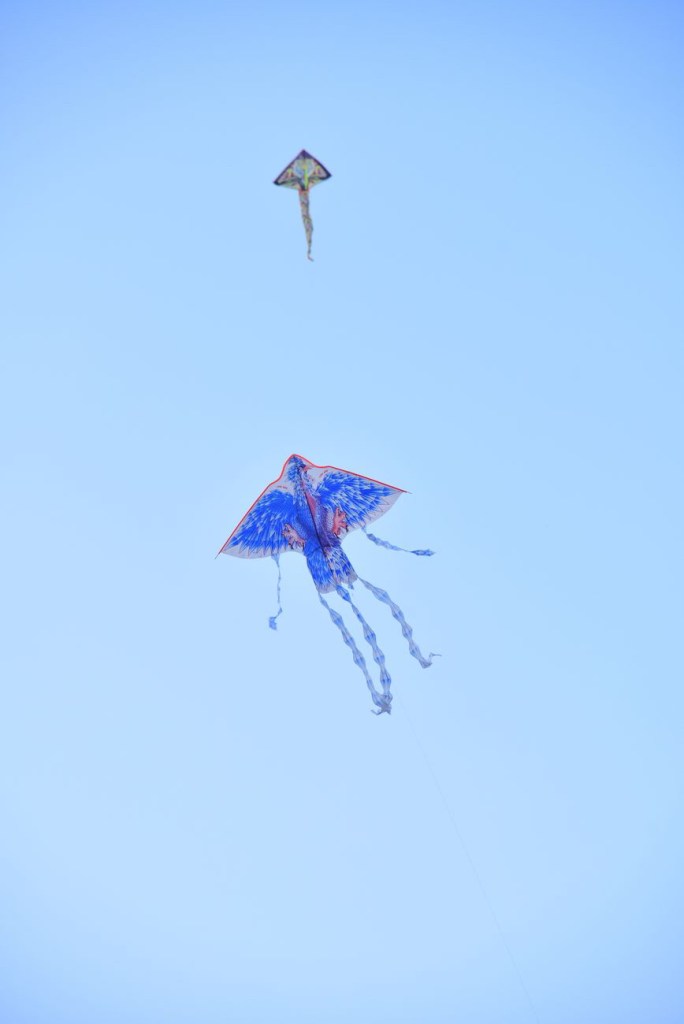
For a moment, I saw mostly blue, flashes of green, and the occasional finger covering half the screen. Then there it was—her brother’s kite, high above the field.
She was very proud of it.
I was impressed too, although my view of the event was slightly less cinematic than hers. She could see an entire field, an open sky, and a kite dancing in the wind. I could see whatever happened to fit inside a small, wildly moving rectangle on my phone.
Then the kite crashed.
And my niece ran after it.
Naturally, she took me with her.
The phone bounced in her hand as she sprinted across the grass, giggling and narrating the unfolding emergency as though she were a field correspondent covering breaking news.
THE KITE IS DOWN. THE KITE IS DOWN.
I saw sky.
Grass.
More sky.
Possibly her elbow.
And somewhere in all that movement, I heard pure childhood happiness.
There was no embarrassment about the kite falling. No frustration that the afternoon wasn’t going perfectly. No analysis of wind direction, no productivity goals, no concern about whether flying a kite was the best use of the next thirty minutes.
The kite crashed.
So they launched it again.
What else would you do?
And as I watched her run around that field, determined to pull me into the moment despite thousands of kilometers between us, something in me became very still.
I realized I wasn’t merely watching my niece.
I was remembering myself.
Before Life Needed a Password
There was a time when I knew this kind of freedom intimately.
Every summer when I was a child, I made my own kites.
Making one was part engineering, part imagination, and probably part optimism considering some of my construction methods.
But when one actually flew?
That was glorious.
There is something especially satisfying about watching a kite you made with your own hands rise into the sky. You watch it climb higher, tugging against the string, and somehow it feels personal.
Almost as though a little part of you has gone up there with it.
I remember wanting to be like that kite.
Free.
Light.
Carried by the wind.
No bills.
No deadlines.
No responsibilities.
No emails politely beginning with “Just following up…”
Childhood freedom was wonderfully uncomplicated.
Back then, I knew nothing about rent or utilities. I did not know that one day I would become genuinely excited when I remembered to pay something before the due date.
I knew nothing about the many lessons involved in becoming what society calls a “proper adult”—a course I appear to be permanently enrolled in with no confirmed graduation date.
My concerns were smaller.
Would the kite fly?
Would the string hold?
Was there enough wind?
Could I stay outside a little longer?
And maybe that is why watching my niece affected me so deeply.
For several minutes, life became that simple again.
Henry David Thoreau once wrote, “You must live in the present, launch yourself on every wave, find your eternity in each moment.” (magicalquote.com)
My niece wasn’t trying to practice mindfulness.
She was seven.
She was simply living.
Perhaps children understand naturally what adults spend years trying to relearn.
Somewhere Along the Way, We Became Busy
Growing older is strange.
As children, we imagine freedom means being an adult.
No one tells us adulthood comes with administrative duties.
You can eat cake whenever you want, yes.
But apparently you must also schedule dental appointments.
Freedom becomes negotiated between obligations.
We begin saying things like:
“I’ll relax after I finish this.”
“I’ll enjoy myself when work settles down.”
“I’ll take that trip someday.”
“I just need to get through this week.”
Then another week arrives wearing exactly the same clothes.
Ralph Waldo Emerson warned, “We are always getting ready to live but never living.” (BrainyQuote)
That sentence stings a little because it is so easy to do.
We prepare for life.
Plan life.
Budget for life.
Organize life.
Photograph life.
Sometimes we become so occupied managing life that we forget to actually inhabit it.
Scripture gives us the simplest possible reminder:
“The Lord has done it this very day; let us rejoice today and be glad.”
— Psalm 118:24, NIV
Not next Tuesday.
Not after everything is finished.
Not once the inbox reaches zero—a mythical event I am increasingly convinced has never happened to anyone.
This is the day.
The ordinary one.
The imperfect one.
The one with unfinished chores, unexpected phone calls, and kites that keep crashing into the grass.
The Kite Was Never Supposed to Stay Up Forever
Maybe that was the lesson hidden inside that afternoon.
The kite kept falling.
Nobody treated this as a tragedy.
It went down.
Someone picked it up.
They launched it again.
Up it went.
Watching from the other side of the world, I suddenly wondered how much happier adulthood might feel if I treated more things that way.
Not every fall needs to become a verdict on my life.
Not every interruption means the day is ruined.
Not every plan needs to work perfectly for the moment to still be good.
Sometimes things fall.
Sometimes we try again.
Sometimes we laugh while doing it.
Jesus said:
“Therefore do not worry about tomorrow, for tomorrow will worry about itself. Each day has enough trouble of its own.”
— Matthew 6:34, NIV
That does not mean responsibilities disappear.
Unfortunately, I have checked.
The bills remain extremely committed to their schedules.
But perhaps responsibility and freedom were never meant to be enemies.
Maybe freedom is not the absence of responsibility.
Maybe it is the ability to be fully alive even while responsibility exists.
What Freedom Looks Like Now
As an adult, my idea of freedom has changed.
It is no longer endless summer afternoons with a homemade kite.
Freedom now sometimes looks like having nothing scheduled.
Like sitting somewhere without needing to accomplish anything.
Like taking a walk without tracking the steps.
Like eating slowly.
Like watching the sky.
Like allowing a moment to exist without immediately turning it into something useful.
And increasingly, freedom means giving myself permission to simply be where I am.
Thich Nhat Hanh wrote, “Life is available only in the present moment.” (Goodreads)
I know that.
Most of us know that.
Remembering it while actually living our lives is the difficult part.
My niece didn’t call because she had learned some profound truth about presence.
She called because her kite was flying and she wanted me to see it.
That was enough.
And maybe that is the beauty of childhood.
Children do not always wait for extraordinary events to share their joy.
A kite is enough.
A sunny field is enough.
A strong breeze is enough.
Someone they love answering the phone is enough.
Maybe adulthood doesn’t need less responsibility.
Maybe it needs more enough.
Soul Insights
1. Joy rarely waits until life is organized.
We often treat joy as a reward we will collect after all our responsibilities have been handled. But there will almost always be another task, another concern, another thing demanding attention. My niece did not wait for the perfect flight before enjoying the kite; even the crashes became part of the afternoon. Perhaps joy is not waiting at the end of our obligations—perhaps it keeps appearing in the middle of them, hoping we will notice.
2. Presence is one of the purest forms of love.
My niece could have simply flown the kite, but she wanted to share it with me. Through a shaky phone screen, she brought me into her world because sharing joy made the joy larger. Presence does not always require being physically beside someone; sometimes it is answering the phone and caring deeply about the thing they are excited to show you. Love often arrives without ceremony and says, Look at this!
3. Falling does not cancel flying.
The kite crashed repeatedly, yet nobody concluded that kite flying had failed. They picked it up, launched it again, and continued. Adults sometimes turn one difficult moment into an entire story about ourselves: I failed. I chose wrong. I should have known better. A kite reminds me that coming down is simply part of learning what it means to rise.
4. The child we once were is not completely gone.
Watching my niece stirred memories that had been sitting quietly inside me for years—the handmade kites, summer afternoons, excitement when something I created finally lifted into the wind. Growing older adds responsibilities, disappointments, wisdom, scars, calendars, and passwords, but somewhere beneath all of that remains the person who once looked at the sky with wonder. Perhaps we do not need to return to childhood; we simply need to make room for that child to occasionally walk beside us.
5. God often hides sacred moments inside ordinary afternoons.
We sometimes expect meaningful experiences to announce themselves dramatically, yet many of them arrive disguised as ordinary life. A child calls. A kite rises. The wind blows. And suddenly an everyday moment becomes a reminder of gratitude, freedom, memory, and grace. Ecclesiastes tells us, “To every thing there is a season, and a time to every purpose under the heaven” (Ecclesiastes 3:1, KJV), and perhaps some seasons last only a few minutes—long enough for us to recognize them before they drift away.
Final Thoughts: Hold the String, Feel the Wind
That phone call ended.
Eventually, the kite came down for good.
The afternoon continued.
My niece went on being seven years old, probably unaware that she had just given me an unexpected lesson about life from a field in New Zealand.
But I kept thinking about her.
Running.
Laughing.
Holding the phone.
Trying to make sure I saw everything.
And I kept thinking about that kite.
Perhaps freedom was never really about having no responsibilities.
Perhaps freedom is being able to step outside them for a moment and remember that life is more than the things demanding something from us.
We will have obligations.
We will have bills.
We will have responsibilities.
We will continue learning how to be adults, apparently through an educational system involving mostly trial and error.
But there must still be room for wind.
There must be room for wonder.
There must be room to do something simply because it makes us smile.
Sometimes life will soar.
Sometimes it will crash into the grass.
Pick it up.
Laugh.
Launch it again.
And every once in a while, when the wind catches it just right, allow yourself to imagine that part of you is flying too.
Your Turn
What ordinary childhood moment still makes you smile?
Maybe it was flying a kite, riding a bicycle until sunset, climbing trees, playing outside after the rain, or spending summer afternoons doing absolutely nothing important.
Think about the child you once were.
What did that version of you know about joy that the adult version of you has forgotten?
Then this week, reclaim one small piece of it.
Not because it is productive.
Not because it belongs on a list.
Just because you are still here.
And the wind is still blowing.
© 2026 Amelie Chambord


Leave a Reply