What Tokyo Taught Me About Solitude, Presence, and Belonging
I learned a new Japanese word on my first full day in Tokyo.
Hitori.
It means “one person” or “alone.”
The word seemed fitting. I had flown across the Pacific alone. I was navigating train stations alone. I was exploring one of the largest cities in the world alone. Later that afternoon, I would sit down for lunch alone and learn the meaning of the word from a ramen shop ordering machine.
Yet the longer I spent in Tokyo, the less that word seemed to describe my experience.
I was certainly far from home. Nearly everything around me was unfamiliar—the language, the customs, the train system, the rhythm of daily life. By every outward measure, I was on my own. Yet I never felt abandoned. In fact, I felt surprisingly accompanied.
That realization began earlier that morning while walking through the forest surrounding Meiji Shrine.
A Forest Inside the City
When most people imagine Tokyo, they picture towering buildings, crowded intersections, and neon lights stretching across the skyline. Those images are accurate, but they are not the images that stayed with me.
The memory I carried home was a forest.
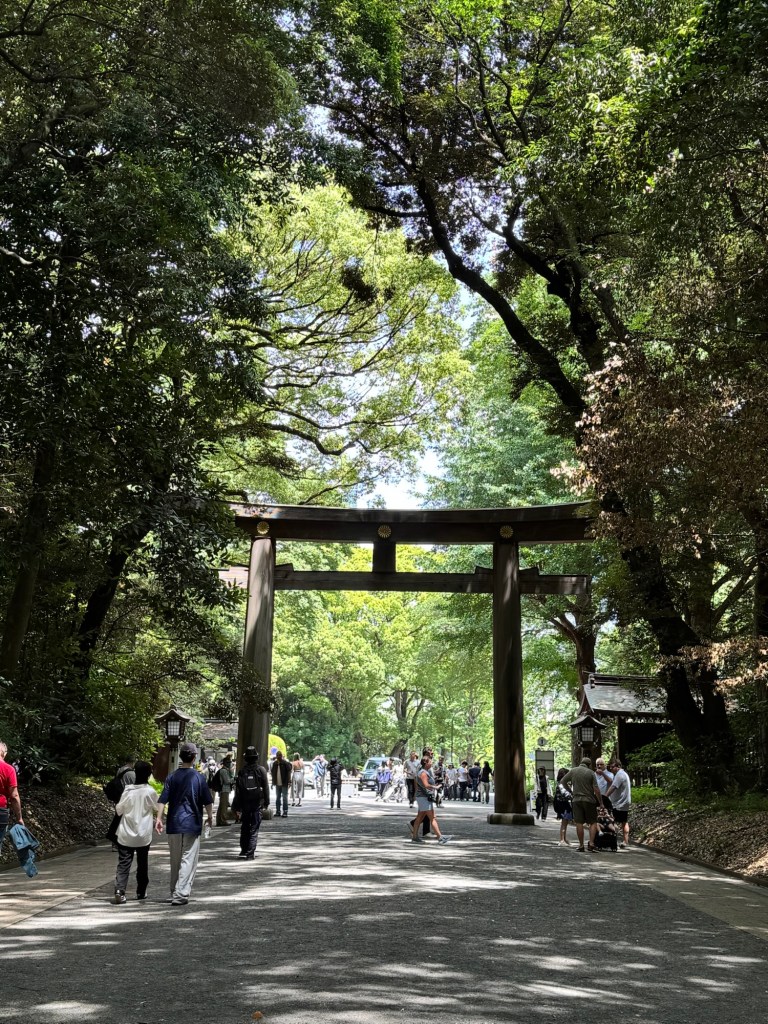
After arriving at Yoyogi Station, I made my way toward Meiji Shrine. The transition felt almost supernatural, reminiscent of the moment in My Neighbor Totoro when the ordinary world quietly gives way to something enchanted. One moment I was surrounded by trains, traffic, and the relentless movement of the city. The next, I was walking beneath towering trees as sunlight filtered through the canopy overhead.
The sounds of Tokyo gradually faded behind me. Gravel crunched beneath my shoes. A gentle breeze moved through the leaves. The deeper I walked into the forest, the more it felt as though I had crossed an invisible threshold into another world.
As I continued along the pathway, I witnessed a traditional Shinto wedding procession moving through the shrine grounds. The bride and groom walked with quiet dignity while visitors respectfully paused to watch. Cameras lowered. Conversations softened. For a few moments, the atmosphere invited everyone into a shared sense of reverence.
Walking beneath the towering trees, I was reminded of Genesis 28:16: “Surely the Lord is in this place, and I did not know it.” Jacob spoke those words after awakening from a dream, but they captured something I was beginning to feel. The forest seemed to reveal a truth that modern life often obscures: sacred moments are not always found in extraordinary places. Sometimes they are waiting quietly in places we least expect.
Whether one approaches those words through faith or simply as an invitation to presence, the wisdom remains timeless. We spend much of our lives moving from one obligation to the next, rarely giving ourselves permission to stop. The forest seemed to offer a different invitation. It suggested that stillness is not empty space but a place where awareness deepens.
As philosopher Blaise Pascal observed, “All of humanity’s problems stem from man’s inability to sit quietly in a room alone.”
Walking beneath those trees, I wondered if our discomfort with solitude causes us to miss some of life’s most meaningful experiences.
The Difference Between Alone and Lonely
Later that afternoon, I found myself standing in front of a ramen ordering machine that seemed determined to humble every foreign visitor who approached it.
After a few moments of confusion, I asked a Japanese couple standing behind me for help. They graciously guided me through the process, helping me navigate the menu and payment system. What could have been an awkward travel moment became one of the most memorable interactions of the day.
The irony made me smile.
I had just learned the word hitori—alone—yet one of the day’s most meaningful moments arrived through human connection.
The experience caused me to reflect on something larger. We often assume that being alone automatically means being lonely. Yet those are not the same thing. Loneliness is the painful feeling of disconnection. Solitude, by contrast, can become a space where connection takes on a different form.
As I thought about this while eating my ramen, my mind drifted toward one of Christianity’s most profound mysteries: the Trinity.
Christians believe that God is one, yet exists as Father, Son, and Holy Spirit. Distinct persons, yet united in perfect communion. It is a concept that stretches the limits of human understanding, but it also suggests something beautiful about the nature of reality itself.
At the center of existence is not isolation but relationship.
Perhaps that is why solitude does not always feel empty. Perhaps we were created by a God whose very nature is communion, which means that being physically alone does not necessarily mean being spiritually isolated.
I came to Tokyo by myself. I walked through Meiji Forest by myself. I sat down for lunch by myself.
Yet I never felt truly alone.
Hearing What the Noise Usually Hides
One of the unexpected gifts of solo travel is the absence of constant distraction.
Back home, life moves quickly. Conversations overlap with responsibilities. Notifications compete for attention. Even good things can create enough noise to prevent deeper reflection.
Tokyo gave me space to hear my own thoughts again.
As I walked through the forest, sat quietly with coffee in the morning, and wandered unfamiliar streets throughout the day, I found myself asking questions that often get buried beneath routine.
What deserves more of my attention?
What am I rushing toward?
What have I been too distracted to notice?
Ecclesiastes 3:1 reminds us that “for everything there is a season, and a time for every matter under heaven.”
Perhaps there is also a season for solitude.
Not as an escape from life, but as a way of returning to it with greater clarity.
Thomas Merton once wrote, “Happiness is not a matter of intensity but of balance, order, rhythm and harmony.”
Tokyo taught me that lesson in an unexpected way. The city offered extraordinary stimulation, yet the moments that nourished me most were the quiet ones.
Knowing When to Go Home
By the time I reached Shibuya Crossing later that afternoon, the contrast could not have been greater.
People flowed through the intersection in every direction. Screens flashed overhead. Energy radiated from every corner. The crossing was fascinating to watch, but after several hours of navigating crowds, I realized something important.
I had reached my limit.
Rather than push myself to keep sightseeing, I decided to head back to Wakamatsu-Kawada. I stopped at 7-Eleven, picked up dinner and water, returned to the Airbnb, took a shower, and spent the evening resting.
It turned out to be one of the best decisions of the day.
Proverbs 19:2 offers a practical reminder: “It is not good to have zeal without knowledge, nor to be hasty and miss the way.”
Travel often encourages us to maximize every moment. Wisdom sometimes encourages us to do the opposite.
Sometimes the most meaningful act of self-awareness is recognizing when enough is enough.
Reflection Questions
- When was the last time I intentionally created space for silence rather than simply waiting for it to happen?
- Do I confuse solitude with loneliness, and what opportunities might I be missing because of that assumption?
- What voices, distractions, or routines might be preventing me from noticing the presence of God in my daily life?
Final Thoughts
When I first encountered the word hitori, I assumed it would become a simple vocabulary lesson from my trip to Japan.
Instead, it became a meditation on belonging.
I was not home. I was thousands of miles away from familiar people, familiar places, and familiar routines. Yet throughout the day, whether I was walking through the quiet sanctuary of Meiji Forest, receiving kindness from strangers, or simply sitting alone with my thoughts, I never felt abandoned.
Perhaps that is the paradox of solitude.
Sometimes we leave home only to discover that we are more deeply accompanied than we realized.
Perhaps being hitori is not about being alone at all.
Perhaps it is about discovering that presence does not depend on proximity, and that even in unfamiliar places, we can find ourselves held by something greater than ourselves.
© 2026 Amelie Chambord


Leave a Reply