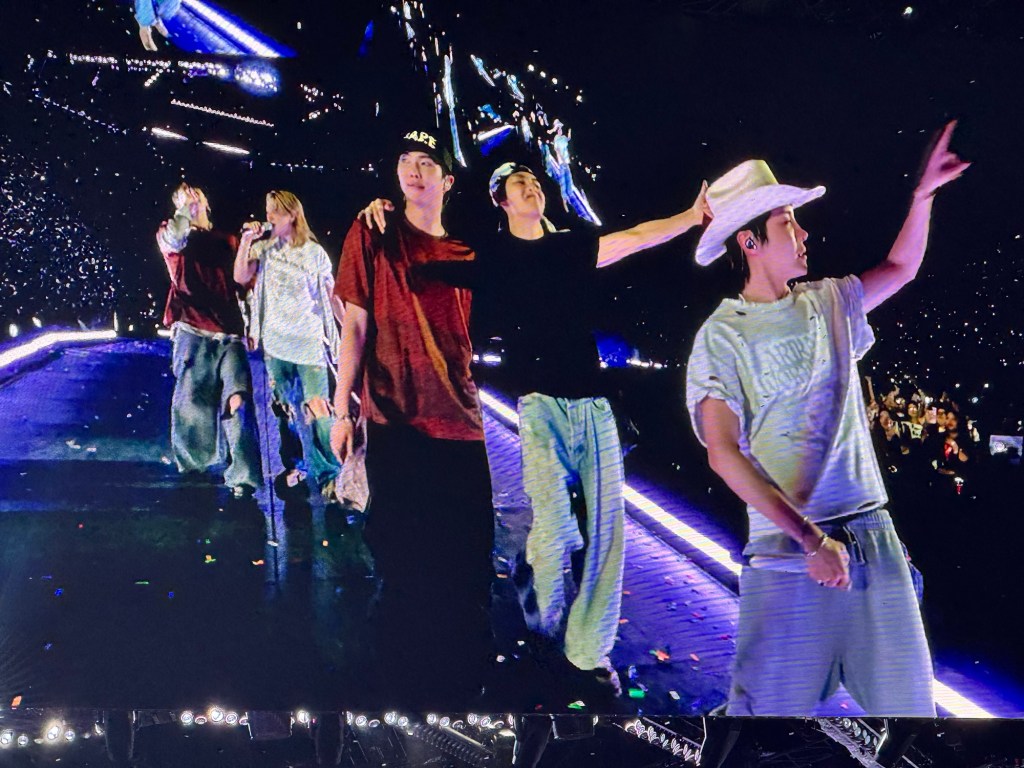
The fifth time I replayed the video, I realized the loudest scream in the clip was over Jin drinking water.
Not singing.
Not dancing.
Not fireworks exploding across the stadium.
Water.
The camera zoomed in on him for maybe three seconds, and the entire crowd reacted like someone had announced world peace. Every time the screen focused on a member, the screaming intensified, even if all they were doing was wiping sweat off their face or catching their breath between songs.
That’s the part I keep replaying.
Not even the performances themselves, although those were incredible. What keeps pulling me back are the in-between moments. The pauses. The teasing. The chaos of seven people trying to talk at once while sixty thousand fans scream over each other trying to process that BTS is physically standing in front of them again.
I think people assume concert videos exist to preserve the performance.
Mine became a way to finish experiencing it.
Before El Paso Became Real
A week before the concert, my life looked completely different.
I had originally planned to stay home, focus on writing, and keep life predictable. Then suddenly I had a BTS ticket and a logistical puzzle sitting in front of me like a final exam written by Ticketmaster and financial anxiety working together as a team.
How was I getting to El Paso without spending too much money?
How was I getting back?
Hotel? Airbnb? Shared room with another ARMY? Women’s resource center? Train? Bus? Combination of all three?
I spent days researching routes, emailing people, comparing prices, and trying to make the trip financially possible without draining myself completely. The concert disrupted my normal rhythm long before I entered the stadium.
In hindsight, that mattered.
Joy feels heavier when effort is attached to it.
“Where your treasure is, there your heart will be also,” Jesus says in Matthew 6:21. The verse is usually applied to money, but attention works the same way. We value what we invest ourselves into.
And I invested a lot just to get there.
Too Much Happening at Once
One thing nobody fully explains about BTS concerts is how difficult it is to know where to look.
The giant screen tells you one thing.
The stage tells you another.
The camera zooms in on whoever is speaking, but meanwhile another member is in the background doing something ridiculous that the stadium screen never catches. Watching BTS together feels like trying to follow seven conversations during a fireworks show.
Even in my own videos, you can see the confusion in the camera angles. I kept moving between the stage and the screen because my brain could not decide what deserved my attention more.
The strange part is that the chaos becomes part of the charm.
RM looks mildly exhausted while the members become increasingly unserious. Jungkook stares at the others just to annoy them. Jimin turns affectionate toward ARMY every chance he gets. Taehyung behaves like a man who wandered in from another dimension and decided to stay for entertainment purposes. Suga maintains the emotional energy of someone observing everything from the outside while quietly judging the nonsense.
Then the members started copying J-Hope’s introduction.
“I’m your hope, you’re my hope, I’m J-Hope.”
Except they replaced his name with theirs because apparently nobody could think of another slogan.
That moment made me laugh harder replaying the clip later than it did live.
Maybe because during the concert itself, my brain was overloaded.
The Brain Cannot Hold Everything’s at Once
The videos surprised me afterward.
Not because they were beautiful. I expected that.
What surprised me was the disbelief I felt watching them alone later.
The overstimulation became obvious once the noise disappeared.
After the concert ended, I walked toward the train station in near silence. Hours earlier, the stadium shook from thousands of people screaming as BTS took the stage. Then suddenly it was just footsteps, distant traffic, and people slowly returning to ordinary life.
That emotional drop felt strange.
Not depressing. Just abrupt.
A few hours earlier, fireworks exploded above the stadium while ARMY bombs lit the entire venue in waves of color. At one point, my own light stick made a popping sound and died because I forgot to replace the batteries. My body was sore from standing for hours. It took nearly two hours just to reach my seat inside the stadium.
Then suddenly I was replaying clips alone on my phone, hearing my own screaming in the background and laughing because I didn’t even recognize myself at first.
“Sometimes you will never know the value of a moment until it becomes a memory,” Dr. Seuss once wrote.
But I think modern life complicates that idea.
Sometimes we know a moment matters while it’s happening, yet the experience moves too fast for the brain to fully absorb it in real time.
That’s why we replay it later.
The Videos Became Evidence
I used to think recording too much ruined concerts.
Now I think the real problem is imbalance.
Recording every second turns people into unpaid camera operators at their own memories. But refusing to record anything at all can leave moments feeling strangely fragile afterward.
The videos became evidence.
Evidence that the members really stood there laughing together again after years apart. Evidence that ARMY screamed over people drinking water like it was a competitive sport. Evidence that happiness existed in physical form for a few hours inside a stadium in El Paso.
Ecclesiastes 3:11 says that God “has made everything beautiful in its time.” Concerts feel like that sometimes. Brief. Temporary. Impossible to fully hold onto once they pass.
Maybe that’s why humans replay joyful memories so obsessively.
Not to replace the experience.
To reopen the door for a few minutes and step inside it again.
Soul Insights
1. Joy overwhelms the brain as much as grief does.
People often talk about emotional overload only in painful situations, but happiness can flood the nervous system too. During the concert, my attention kept splitting because too much was happening simultaneously. The brain could not organize every sound, movement, scream, and interaction fast enough. Replaying the videos later became a slower way of processing what I already lived through physically. Joy sometimes arrives faster than comprehension.
2. Tiny moments become emotional anchors.
The clips I replay most are not the polished performances. They are the small, unserious interactions between the members. A joke, a stare, someone copying J-Hope’s introduction, or hearing the crowd react to water drinking somehow became more memorable than choreography. Humans remember emotional texture more than perfection. Personality leaves a deeper imprint than spectacle.
3. Presence and documentation will always compete with each other.
Part of me wanted to stay fully immersed in the concert. Another part wanted tangible proof that it happened. That tension never fully disappears in modern life because phones allow us to archive nearly everything. Balance matters more than extremes. I realized I would rather preserve meaningful interactions than entire songs I could already find online later.
4. Silence after collective joy feels physically strange.
Walking toward the train station afterward felt almost unreal because the emotional atmosphere disappeared so suddenly. Stadium energy trains the nervous system to stay elevated for hours. Then reality returns all at once. That transition explains why people replay clips immediately after concerts instead of waiting weeks later. The brain is trying to soften the emotional whiplash between extraordinary moments and ordinary routines.
5. Memories fade faster than we want to admit.
I used to believe important memories naturally stay sharp forever. They do not. Details blur. Faces soften. Sounds disappear first. Videos cannot perfectly preserve a moment, but they can reactivate emotional memory long after the event itself has ended. In some ways, they become modern memory keepers.
Final Thoughts
I still replay the clips.
Not constantly. Not obsessively.
Just enough to hear the crowd again. Just enough to laugh when the members start teasing each other. Just enough to remember what it felt like when the stadium lights dimmed and sixty thousand people lost their minds together for a few hours.
Next time, I probably will record less.
But I will still save the ending ments.
Because those are the moments when BTS stop feeling like distant global superstars and start feeling like seven people standing in front of ARMY trying to hold onto the night a little longer too.
As Psalm 16:11 says, “You make known to me the path of life; in your presence there is fullness of joy.”
Some moments remind us what fullness feels like.
Sometimes replaying the memory is our way of saying thank you for having lived it at all.
© 2026 Amelie Chambord


Leave a Reply