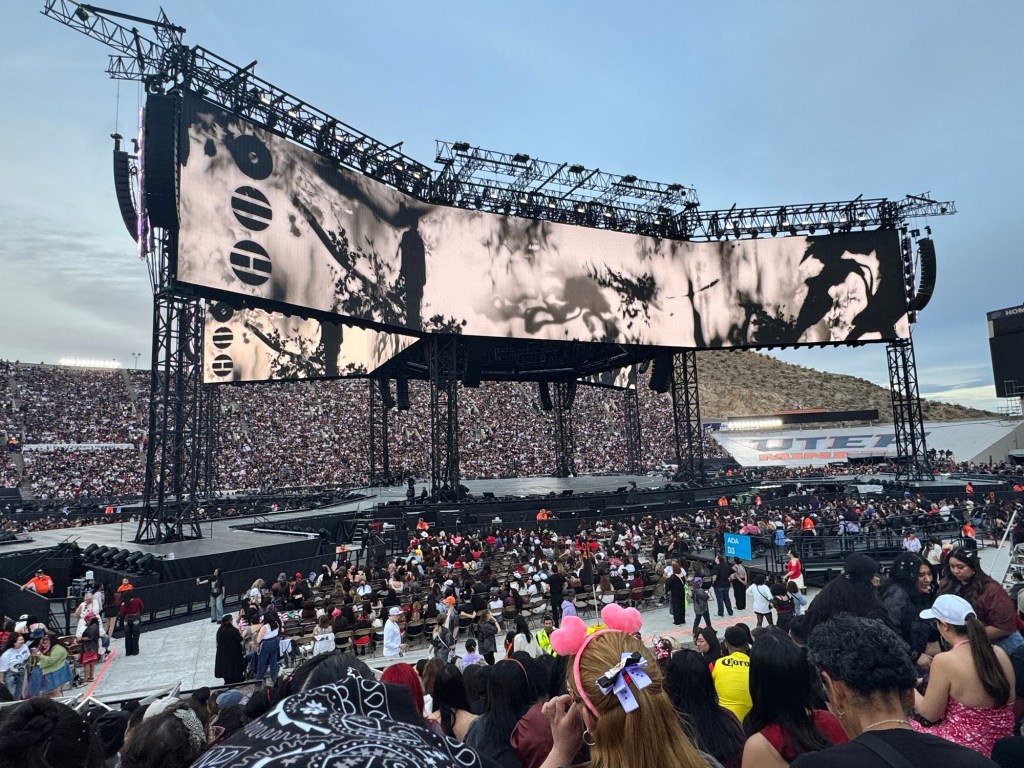
The concert started before the first note.
Lights dropped. Screens rose.
Not a few people. Almost everyone. Thousands of phones lifted at once, glowing rectangles blocking the stage they were trying to capture. It happened in seconds, like a reflex the crowd had practiced.
I followed it.
Camera open. Recording.
BTS had barely started the first song, and I was already watching them through my phone.
Watching Through a Screen
For the first few minutes, I split my attention.
One part of me tracked the performance. The other managed the recording. I adjusted my grip, checked focus, followed movement through a five-inch screen instead of the full stage in front of me.
When a member crossed from left to right, I followed through the lens.
When the lighting shifted, I checked exposure instead of looking at the stage.
The performance was live.
I was managing a recording.
Pico Iyer’s line came to mind with uncomfortable accuracy: “Wherever you are, be there totally.” I wasn’t. I was physically present and mentally occupied with capturing something I might never watch again.
I lowered my phone.
No buildup. No internal debate.
Just a clear switch.
What Changed Immediately
Without the phone, I stopped anticipating movement for the sake of the shot.
I followed what was happening in real time.
When the music shifted, I felt the transition instead of checking if it was worth recording.
When the crowd reacted, I joined them instead of stabilizing a frame.
Details became specific.
The stage lights extended past the main platform and reached the upper sections.
Fan chants landed in sync across thousands of people, not delayed, not scattered.
The members paced themselves between songs, conserving energy, then pushing hard during choreography.
None of that required a screen to notice.
The Trade No One Names
Recording feels like preserving a moment.
In practice, it often replaces the experience of it.
Psychologists call this cognitive offloading. You record something so you don’t have to fully process it now, assuming you’ll revisit it later.
Most people don’t revisit it.
The video sits in storage.
The moment is gone.
Gretchen Rubin put it plainly: “The days are long, but the years are short.” Nights like this move fast. If attention isn’t there while it’s happening, it doesn’t get rebuilt later from a clip.
The Crowd Around Me
Phones stayed up for entire songs.
People tracked every movement through their screens. Some watched the jumbo screen through their phone instead of looking directly at it. The experience passed through layers before reaching them.
No one was wrong for doing it.
But the cost was visible.
Every second spent adjusting a shot was a second not spent actually seeing what was happening.
What I Got Back
With my phone down, the experience sharpened.
I saw how the stage design pulled focus across sections.
I heard how the crowd carried the rhythm during certain songs.
I noticed how the members moved differently depending on the tempo and sequence.
Nothing about the concert changed.
My level of attention did.
Psalm 46:10 says, “Be still, and know that I am God.” That instruction is about attention. In a stadium filled with noise and movement, stillness looked like one decision.
Stop recording.
What Stayed With Me
By the end of the concert, my camera roll was minimal.
A few short clips. A few photos.
But I remembered the setlist order, specific transitions, and exact moments where the energy shifted across the stadium.
Not because I recorded them.
Because I paid attention while they were happening.
Matthew 6:21 says, “Where your treasure is, there your heart will be also.”
Attention follows the same rule.
Where it goes determines what you actually experience.
Soul Insights
1. Attention cannot be split without losing depth.
Trying to watch and record at the same time creates two partial experiences instead of one complete one. The brain shifts into task mode when managing a device, which pulls focus away from the moment itself. What feels like multitasking is actually constant switching. That switching weakens memory formation and emotional impact. Full attention produces a stronger and more lasting experience.
2. Recording creates the illusion of control.
Holding a phone during a live event gives a sense that the moment is being secured. In reality, it redirects focus toward managing the capture instead of living through it. The desire to preserve can override the ability to engage. Over time, this builds a habit of observing life instead of participating in it. Letting go of that control restores presence.
3. The most valuable moments don’t need proof.
Not every experience requires documentation to be meaningful. The pressure to capture everything often comes from external expectations rather than internal value. When attention is fully present, the need for validation through recording decreases. Memory becomes the primary record. That shift strengthens personal connection to the experience.
5. Presence amplifies detail.
Without the distraction of a screen, sensory input becomes clearer and more immediate. Visual, auditory, and emotional elements register more strongly. This leads to richer memory formation and a more immersive experience. Presence doesn’t add something new to the moment; it reveals what was already there. The difference is in what gets noticed.
Final Thoughts
The shift was simple.
Stop recording.
Start paying attention.
The concert didn’t change.
My experience of it did.
What felt distant through a screen became immediate without it.
Your Turn
At your next concert, try this.
Record one moment.
Then put your phone away.
Watch what happens to your attention when nothing stands between you and the experience.
© 2026 Amelie Chambord


Leave a Reply