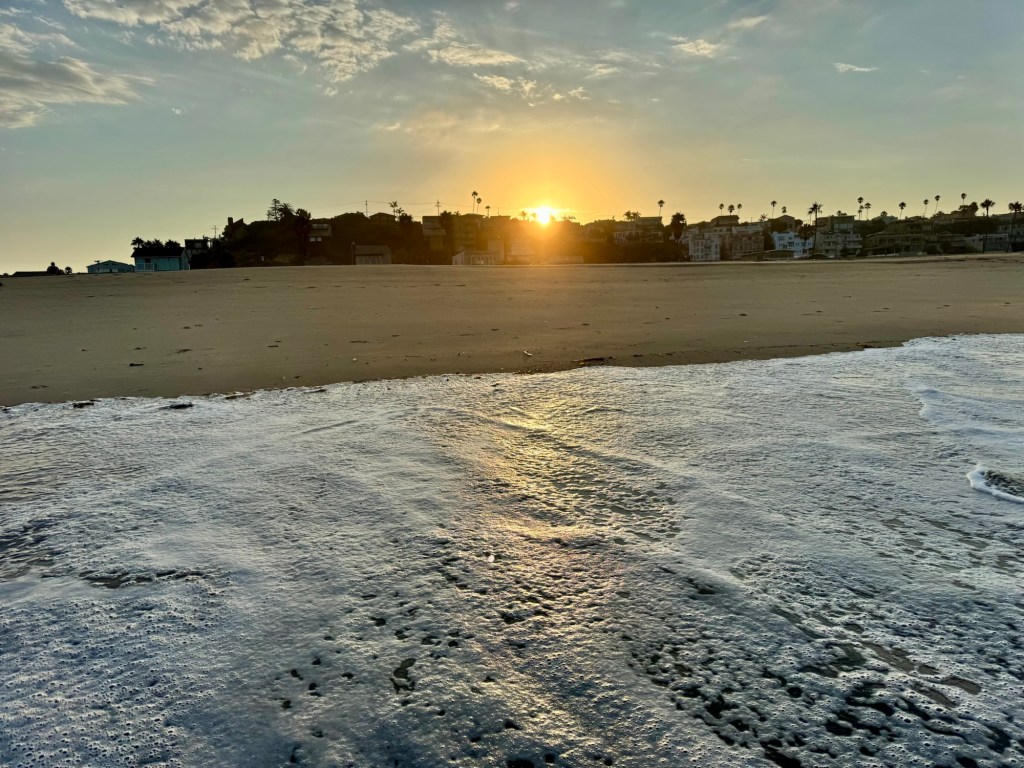
The first embrace of the ocean that morning was cold and unexpected. I had barely stepped onto the wet sand when a wave rushed forward, wrapping itself around my legs like a hug I didn’t see coming. It startled me, but it also grounded me. I knew in that moment: I had arrived at my altar for the day.
Playa del Rey looked different that Sunday morning. The rocks I had seen scattered across the shoreline just a day before had vanished—pulled back into the sea overnight. In their place were small sea creatures washed ashore, some already lifeless, others fragile and struggling. The waves kept moving, curling and breaking, relentless in their rhythm. Everything about the scene whispered impermanence: what was once here is gone, what washes up today might be gone tomorrow.
And yet, the rhythm of the waves never stopped.
Psalm 42:7 says, “Deep calls to deep in the roar of your waterfalls; all your waves and breakers have swept over me.” Standing there, I understood it in a new way. The waves that startled me, chilled me, embraced me—they were not random. They were messengers of God’s presence, reminders of His power to renew, cleanse, and overwhelm me in love.
Waves as Embrace and Overwhelm
It’s not always easy to welcome being “swept over.” We usually want God’s presence to be gentle, like a quiet stream. But more often than not, His love feels like breakers crashing—disruptive, loud, and impossible to ignore. The shoreline showed me what the psalmist knew: the deep parts of us are met by the deep parts of God not in safety, but in surrender.
C.S. Lewis once wrote, “God whispers to us in our pleasures, speaks in our conscience, but shouts in our pains: it is His megaphone to rouse a deaf world.” Sometimes His voice is as subtle as a seashell in the sand. Other times, it is as undeniable as a wave that drenches you unexpectedly. Both are His presence. Both are His embrace.
As I walked along the beach, I thought about how easily I attach meaning to small gestures in my life—an open car door, a shared laugh, an unexpected text. It’s tempting to read every wave as a sign of what’s coming. But the ocean reminded me that not every gesture is a roadmap; some are simply gifts of the moment. God’s waves are not always instructions; sometimes they’re simply love rushing in.
God’s Cleansing Power
The waves didn’t only bring beauty that morning. They brought debris. Broken shells. Plastic bags. The carcasses of tiny sea dwellers. At first glance, it seemed messy and harsh. But then I realized: this is how the ocean cleanses itself. What is hidden beneath the surface eventually washes up, exposed to the light, no longer festering in the deep.
In the same way, God doesn’t let me hold onto toxins forever. He has a way of bringing things up—old habits, buried pain, false attachments—and laying them before me on the shore of my awareness. It feels uncomfortable. Sometimes it even looks ugly. But it is always renewal.
As author Richard Rohr says, “The pain we do not transform, we will most assuredly transmit.” God doesn’t expose our debris to shame us, but to free us. The waves remind me: what He surfaces, He intends to wash away.
Scripture echoes this promise: “If we confess our sins, He is faithful and just and will forgive us our sins and purify us from all unrighteousness.” (1 John 1:9). The waves don’t just reveal; they purify.
Fragility and Companionship
As I looked at the lifeless sea bugs and tiny creatures washed up on shore, I couldn’t help but think of fragility. Some of them seemed young, as if they had never fully lived. Life is so brief, so delicate.
That morning, I also carried with me the weight of human relationships—companionship that feels nourishing, conversations that go deep, laughter that heals. There are moments of joy with people in my life, but there is also uncertainty, timing, and the awareness of age and difference. I’ve had to remind myself not to attach too much meaning too quickly, to protect my heart while still staying open.
The waves taught me something here too. They don’t cling to the sand. They come, they go, they return again in rhythm. If I live in fear of loss, I miss the gift of the moment. If I grasp for permanence, I forget that even the shore is shifting. But if I let the waves teach me, I can hold relationships as they are: gifts, for however long God allows, without forcing them into something more.
Poet Rainer Maria Rilke once said, “Let everything happen to you: beauty and terror. Just keep going. No feeling is final.” Standing at the shore, I understood: no wave is final. And no season of life is either.
Renewal as a Daily Rhythm
As I walked back toward my car, the sun rising behind me, I thought about how every morning is a chance for renewal. The ocean doesn’t stop breaking, doesn’t stop cleansing, doesn’t stop carrying debris away. Neither does God.
Lamentations 3:22–23 says, “Because of the Lord’s great love we are not consumed, for His compassions never fail. They are new every morning; great is Your faithfulness.”
Every day, He brings new waves. Some will shock me. Some will soothe me. Some will sweep away what I no longer need. But all of them will carry His presence.
Philosopher Alan Watts once wrote, “You are not a drop in the ocean. You are the entire ocean in a drop.” That morning, I felt this truth. If God is the ocean, I am a droplet—and yet, in Him, I am connected to the whole. His breakers are not just around me; they are in me.
Soul Insights
1. God’s presence is not always gentle.
We often crave a soft encounter with God—like a gentle stream we can dip our toes into. But His presence is not always like that. Sometimes it comes crashing like a wave, sweeping away our balance, leaving us gasping for air. And yet, even in that shock, there is embrace. When I felt the wave rush around my legs that morning, I realized: this is how God moves. He startles us, disrupts us, and refuses to let us remain in control. Just as the psalmist cried in Psalm 42:7, “all your waves and breakers have swept over me,” I felt both overwhelmed and held. God’s love is not domesticated; it is wild, untamable, and relentless—and that is precisely why it saves us.
2. Renewal requires release.
The beach wasn’t just littered with beauty that morning—it was scattered with debris. Seaweed, plastic, broken shells, and tiny lifeless creatures all lay exposed on the sand. At first it seemed harsh, but then I realized: the ocean was cleansing itself. It was bringing up what didn’t belong, flushing out what could no longer stay hidden. Isn’t that what God does with us? The things we bury—resentments, regrets, patterns of sin—He eventually surfaces. It’s rarely pretty, but it’s necessary. As 1 John 1:9 reminds us, “If we confess our sins, He is faithful and just… and will purify us.” Renewal is impossible without release. We cannot cling to yesterday’s debris and still expect tomorrow’s clarity.
3. Fragility is part of beauty.
I lingered over the sight of small sea bugs and creatures washed ashore, many of them young, their lives cut short. At first I felt sadness, but then I recognized the reminder: life is fragile, and that fragility is part of its beauty. Every heartbeat, every friendship, every morning sunrise is a borrowed gift. We are not promised permanence here, but we are promised presence—God’s presence with us through it all. Psalm 90:12 says, “Teach us to number our days, that we may gain a heart of wisdom.” To see life’s brevity clearly is not to despair, but to live more intentionally. The shoreline reminded me that cherishing the moment—whether in laughter with a friend, or quiet prayer at dawn—is how we honor the fragility of our days.
4. Companionship is seasonal and sacred.
As waves rush in and out, they never cling to the sand—they come, they go, they return again in rhythm. Relationships in my life often feel the same. Some are here for a season, some for a lifetime. When I try to force permanence, I lose the gift of the present. That morning, as I reflected on friendships and companionships, I was reminded not to attach too much meaning too quickly. Protecting my heart doesn’t mean closing it—it means holding relationships lightly, trusting God’s timing and purpose. The poet Rilke once wrote, “No feeling is final.” No wave is final either. Every relationship is part of a greater tide, sacred because it flows through God’s hands before it ever reaches mine.
5. Every morning is mercy.
The sun was just beginning to rise as I turned back toward my car, the waves still rolling in behind me. I was struck by the realization that every single day is a fresh tide of mercy. Just as the ocean never stops breaking, God never stops renewing. His love is not seasonal—it is daily, moment by moment. Lamentations 3:22–23 captures it: “His compassions never fail. They are new every morning; great is Your faithfulness.” Each dawn is a reminder that yesterday’s debris has been carried away, and today’s shoreline is washed clean. That morning at Playa del Rey, I felt God’s faithfulness in every foamy wave and every ray of light. To wake, to breathe, to begin again—that is mercy.
Self-Assessment Questions
1. What “debris” is God bringing to the surface in my life that I need to release?
2. How am I experiencing His waves right now—as gentle streams, or as crashing breakers?
3. In what ways can I hold my relationships and circumstances with open hands, like the shifting tide?
Final Thoughts
When the psalmist wrote, “Deep calls to deep… all your waves and breakers have swept over me,” he wasn’t describing a safe, tidy encounter with God. He was describing a surrender. The kind that feels like drowning but is actually being reborn.
Standing on the shore at Playa del Rey, I realized that the ocean is both terrifying and comforting. It breaks what needs to be broken, surfaces what needs to be released, and rushes toward me with relentless love. Every wave is both embrace and undoing.
So when the waves break in my life—through unexpected change, deep conversations, fragile moments, or even loss—I can remember that they are not random. They are part of God’s rhythm of renewal.
The ocean will always call us deeper. The question is: will we let the waves wash over us?
© 2025 Amelie Chambord

 Soul Path Insights
Leave a comment