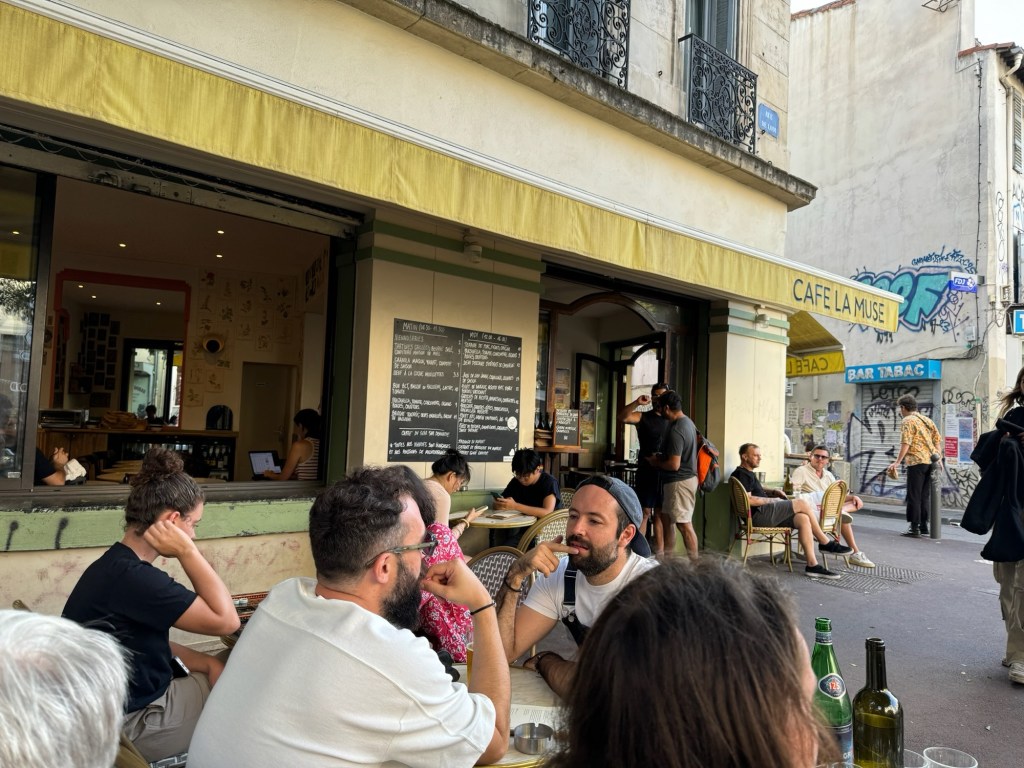
There we were, sitting at Café La Muse in Marseille, enjoying a glass of wine and soaking in the busy, vibrant atmosphere. The tables were packed tightly together, making it easy to overhear the conversations happening all around us. It was one of those outdoor sidewalk setups, where you could hear the hum of chatter mixed with the sound of cars passing by. The waiters were bustling, just two or three of them weaving through the crowd, trying to keep up with the orders. Despite the chaos, it was a friendly, lively scene.
After a day of walking through Cours Julien, we decided to relax before dinner by immersing ourselves in the neighborhood’s ambiance, reading books over a glass of wine. My friend and I had developed a routine, taking turns picking up the tab. That day, it was my turn.
Now, it had been a while since I’d spoken French regularly, so my skills were a little… rusty. To be honest, I often relied on my friend, who seemed much more confident in navigating conversations. He did most of the speaking throughout our trip, but I figured I’d give it a go this time.
I walked up to the counter and greeted the waiter with a confident “Bonjour!” We had a nice back-and-forth in French, and I was feeling pretty good about it. That is, until he asked me which table we were at. I stared at him for a second, knowing we were at table 120, but I completely blanked on how to say it in French. So, in a moment of panic, I just said, “Table one-twenty” in English.
The waiter paused, gave a polite smile, and with a touch of irony, said, “Good French.” And if that wasn’t funny enough, a French lady nearby overheard and laughed—because clearly, my attempt at blending in had failed spectacularly. My friend had done most of the talking during our trip, and the one time it was my turn, well, let’s just say I gave away my tourist status!
It’s moments like this that make traveling so memorable. I couldn’t help but laugh at myself—sometimes, language barriers create the best stories. As Virginia Woolf once said, “Language is wine upon the lips,” but in my case, it came with a side of confusion and good humor!
Life doesn’t require us to be perfect, just present. Whether it’s a language slip or a cultural mishap, there’s always room to laugh and embrace the moment. The key is to keep trying, even if you forget how to say 120 in French!
Soul Insights
1. Embrace Imperfections
In life, just like in language, you won’t always get it right, and that’s okay. Sometimes the most memorable experiences come from the moments where things don’t go as planned. Instead of striving for perfection, embrace the awkwardness and imperfections. They often make for the best stories and offer the chance to laugh at ourselves. It’s in these moments that we learn to let go and enjoy the journey.
2. Confidence is Built Through Practice
Even when you don’t feel as confident as the person next to you, stepping up and trying—like you did with your French—is how confidence grows. You don’t need to get it right every time; the mere act of trying is where the growth happens. Just like in any new situation, with time and practice, what once felt uncomfortable will start to feel natural.
3. Cultural Immersion Teaches Resilience
When we immerse ourselves in another culture, we’re bound to face challenges, whether it’s language barriers or unfamiliar customs. These challenges teach us resilience. In those moments of discomfort or confusion, we’re reminded that learning and growth happen outside our comfort zone. Each stumble is part of the adventure, helping us to become more adaptable and open to new experiences.
4. Laughter is the Best Response to Life’s Mishaps
Life is filled with moments where things don’t go as smoothly as we planned—whether it’s forgetting a word in another language or facing unexpected twists in our journey. In these moments, humor becomes a powerful tool. Laughter not only lightens the situation, but it also reminds us not to take ourselves too seriously. Life flows better when we can laugh through the stumbles.
5. Presence Over Perfection
At the end of the day, life isn’t about being perfect. It’s about being present. Whether you’re navigating a conversation in another language or experiencing a new city for the first time, the magic is in fully engaging with the moment. Even if you make mistakes along the way, being fully present allows you to appreciate the experience for what it is—an opportunity to learn, laugh, and live.
© 2024 Amelie Chambord

 Soul Path Insights
Leave a comment